NAATI CCL Passing Score 2026: How Marks Are Calculated
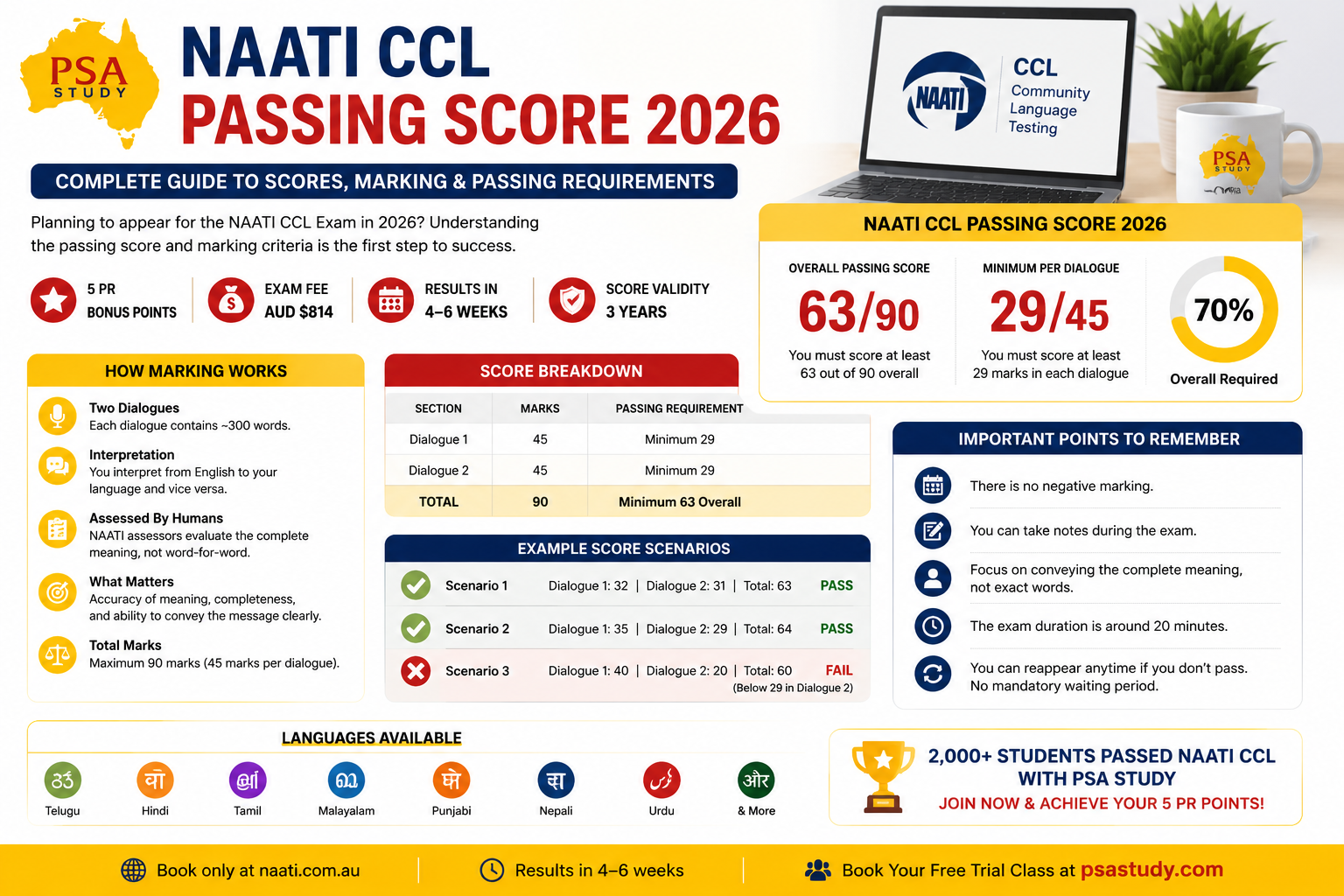
Table of Contents
ToggleEvery year, candidates walk out of their NAATI CCL exam certain they passed and open their results four weeks later to find 58, 60, or 62. Three marks below the line. Sometimes one vocabulary error short.
The frustration isn’t just the result. It’s that they didn’t know it could happen. They prepared. Their language is strong. Yet the NAATI CCL passing score of 63 out of 90 stayed just out of reach and nobody told them exactly where those marks went.
Almost every near-miss comes down to the same three or four things: a missed term in segment three, a second replay that costs a mark, an omitted phrase in the Social Services dialogue. These are specific. They’re learnable. And they’re almost entirely preventable once you understand how the scoring system actually works. This guide breaks it down completely.
PASS MARK: 63 out of 90 marks required to pass. That is 70% of total marks available. You have 27 marks of buffer across a 10-segment exam here is exactly how fast that buffer can disappear.
What the NAATI CCL Passing Score Covers: Exam Structure
Ninety marks. Ten segments. Nine marks each. Completely equal weighting across every part of the exam.
That equal weighting matters. No segment is worth more than another, and no topic category carries extra weight. A Legal and Justice dialogue carries the same nine marks as a Housing and Accommodation dialogue. This has a direct impact on how you prepare candidates who spend 80% of their time on Health and Medical because they work in healthcare are taking the same risk as candidates who skip Employment vocabulary entirely. Both are betting the exam gives them only the topics they prepared for.
One design feature works in your favour: there is no minimum score required per dialogue. Your combined total across all ten segments determines your pass or fail. A weaker opening dialogue followed by a strong second can still get you to 63. Candidates who feel their first dialogue went poorly sometimes mentally check out before the second. That decision costs more marks than the first dialogue did.
| Component | Detail | Marks |
|---|---|---|
| Dialogues in the exam | 2 separate community conversations | — |
| Segments per dialogue | 5 segments each | — |
| Total segments | 10 (5 per dialogue) | — |
| Marks per segment | Fixed equal allocation | 9 marks |
| Total available marks | 10 × 9 | 90 marks |
| Pass mark required | 70% of total | 63 marks |
| Maximum marks you can lose and still pass | 90 − 63 | 27 marks |
The 10 NAATI CCL Topic Categories
You find out which two topics appear in your exam when the audio begins not before.
That’s deliberate. The exam is designed to test preparation across all ten community topic categories, not just the ones you find easiest. Candidates who selectively avoid topics they find difficult routinely encounter exactly those topics in their exam. Based on PSA Study’s coaching data across 2,000+ students, the categories that produce the highest vocabulary-related mark losses are Legal and Justice, Social Services, and Employment three areas many candidates underestimate because they have no prior Australian context for the terminology.
The Ten Categories are:
- Immigration and Citizenship: visa processes, PR applications, citizenship ceremonies
- Legal and Justice: court proceedings, police matters, statutory declarations, fines
- Health and Medical: GP consultations, hospital admissions, prescriptions, mental health plans
- Education: school enrolment, TAFE, special needs support, parent-teacher communication
- Employment: workplace rights, redundancy, WorkCover, Fair Work, payslips
- Social Services: Centrelink, NDIS, disability pension, aged care, emergency relief
- Banking and Finance: loans, financial hardship, insurance claims, account disputes
- Housing and Accommodation: rental agreements, maintenance requests, bond, utilities
- Community Services: local council, disability programs, community support organisations
- Family and Relationships: family court, child support, domestic matters, family services
Each category has its own vocabulary register. Legal dialogues use precise statutory language where approximation costs marks. Social Services uses Australian government terminology that has no equivalent in other countries. Health dialogues require exact clinical terms. Each category requires its own preparation: a specific vocabulary, not just knowledge about the topic in general.
Try a free NAATI CCL mock test before your exam at psastudy.com/naati-ccl-mock-test/ to get a picture of how these topic categories play out in practice.
Deduction Model What Costs You Marks
NAATI assessors will listen to your audio recording and compare to the original dialogue. They use a deduction model for each segment where you start with 9 marks and marks are deducted for each type of error. Your final score is the sum of what you retained.
Knowing the error types changes how you prepare. Most candidates focus on vocabulary and vocabulary is critical. But candidates who lose marks through omissions (missing information that was in the dialogue) often fail for reasons that have nothing to do with vocabulary and everything to do with note-taking under time pressure.
| Error Type | Deduction | Example |
|---|---|---|
| Omission of critical information | 1–3 marks | Missing 'right to remain silent' in a legal dialogue |
| Incorrect meaning conveyed | 1–3 marks | Interpreting 'bail' incorrectly or omitting bail conditions |
| Significant vocabulary error | 1–2 marks | Wrong medical term that changes the clinical instruction |
| Extra replay (beyond the free one) | 1 mark per replay | Third replay of same segment costs 1 mark |
| Mispronunciation affecting meaning | 1 mark | Pronunciation that causes listener confusion about the term |
| Self-correction used well | No deduction | Catching and fixing your own error mid-interpretation |
| Natural pause or brief hesitation | No deduction | A pause that doesn't affect meaning delivery |
| Regional accent with clear meaning | No deduction | Accent in English or community language |
The pattern behind most 54–62 scores: candidates lose 2–3 marks across five or six segments through a combination of vocabulary errors and omissions. That’s 10–18 marks gone not through one catastrophic moment, but through a slow consistent leak across the exam. Fixing that requires preparation that covers both vocabulary and note-taking under pressure, not one or the other.
The Free Replay: One of the Most Misused Tools in the Exam
Every candidate gets one free replay of each segment. Most candidates either never use it or use it too many times.
Not using it costs marks. A term heard once at normal conversational speed in an unfamiliar community context gets misheard or partially missed. That’s a two-mark deduction that four seconds of replay would have prevented.
Overusing it costs marks too. Each replay beyond the first costs exactly one mark from your nine for that segment. Candidates who request three replays of the same segment have already lost two marks before they’ve spoken a word. In an exam where the difference between 61 and 63 is everything, that compounds quickly.
The right approach: use your free replay any time you’re uncertain about two or more terms, or when audio quality makes a word unclear. Take your notes during the replay. Commit from there no second guessing, no third replay.
PSA Study coaches train this decision as a skill in every mock session. It needs to be automatic on exam day, not something you’re working out for the first time under pressure.
NAATI CCL Passing Score Bands: What Your Result Means
| Score | Percentage | What It Means |
|---|---|---|
| 75–90 | 83–100% | Strong pass - high accuracy and confident vocabulary across all 12 topics |
| 63–74 | 70–82% | Pass - NAATI CCL certificate issued, 5 PR bonus points granted |
| 54–62 | 60–69% | Near miss - typically vocabulary gaps and limited mock test experience |
| 45–53 | 50–59% | Significant accuracy gaps -structured coaching needed before resitting |
| Below 45 | Under 50% | Foundational preparation required before resitting |
The 54–62 band is where structured coaching delivers the most dramatic results. Candidates here almost always have strong language ability the gap is topic-specific vocabulary and no structured mock experience. A focused four-week preparation program moves most of them into the 63–74 pass band on their next sitting.
If you scored in this range and want to identify exactly where your marks went, PSA Study’s NAATI CCL coaching programs include mock test analysis with segment-level feedback:
- NAATI CCL Telugu coaching Australia
- NAATI CCL Hindi coaching Australia
- NAATI CCL Tamil coaching Australia
- NAATI CCL Malayalam coaching Australia
Five Preparation Practices That Raise NAATI CCL Scores
The highest-scoring candidates in PSA Study’s programs are not always the most fluent. They’re the most deliberate about the specific skills the NAATI CCL tests.
1. Build topic vocabulary first, then practise dialogues
Your vocabulary ceiling determines your accuracy ceiling. A student with no knowledge of ‘WorkCover claim’ in Telugu cannot accurately interpret a WorkCover dialogue regardless of general Telugu fluency. Start vocabulary preparation by topic category, two weeks before mock test practice begins
2. Develop a note-taking shorthand and practise it every session
Notes taken during audio playback are your anchor for your spoken interpretation. Notes that take too long to write cost more than they save. Build a personal shorthand abbreviations, symbols, whatever works for you and practise it until it operates without conscious effort
3. Complete at least five full mock tests before sitting
Format familiarity reduces day-of errors by 20–30%. The first mock test almost every candidate sits reveals structural problems timing, note-taking gaps, replay hesitation that have nothing to do with language ability. Fixing those before the real exam prevents mark losses that are entirely unrelated to interpreting skill
4. Prioritise accurate meaning over fast delivery
NAATI assessors do not penalise reasonable pauses. They do penalise omissions. A slightly slower, complete interpretation scores higher than a quick one that drops a critical term. There is no countdown timer on your spoken response
5. Use the free replay with a clear decision rule
One free replay per segment, used when genuinely uncertain about two or more terms, prevents more mark losses than almost any other single behaviour. Use it without hesitation. Don’t request a second.
Want to see what your exam preparation is missing? For NAATI CCL exam dates and booking details visit psastudy.com/naati-ccl-exam-dates-2026/.
Frequently Asked Questions
The NAATI CCL passing score is 63 out of 90 marks - 70% of the total across 10 exam segments. There is no minimum required per dialogue. Your combined score across all segments determines your pass or fail result.
No. NAATI CCL uses a total score model. A stronger performance in the second dialogue can compensate for a weaker first. You need 63 across the full exam, not a minimum within each dialogue separately.
No. Regional accent is not penalised as long as the meaning is clearly conveyed. The exam measures interpreting accuracy whether the correct meaning is conveyed between English and your community language. Pronunciation only costs marks if it creates genuine ambiguity about the term being used.
NAATI does not publish an official pass rate. Candidate self-reporting and coaching data indicate roughly 55–65% of candidates pass on their first attempt without structured coaching. PSA Study's students achieve a 99% pass rate on their first sitting, built across 2,000+ coached Telugu, Tamil, Hindi, and Malayalam candidates.
No. NAATI releases your total score and a pass or fail result only. Individual segment scores are not disclosed. Your total score relative to the 63-mark threshold is the main data point for gauging how much preparation you need before resitting.
Losing marks on mock tests and not sure where?
PSA Study trainers identify exactly what is costing you marks. Book your free trial class at psastudy.com