NAATI CCL Tamil Preparation: 4-Week Guide to Pass First Time
Table of Contents
ToggleNAATI CCL Tamil preparation is not a four-week vocabulary sprint. For most Tamil-speaking candidates in Australia, the gap between their first mock test score and their exam result comes from preparation that addressed the wrong problems in the wrong order.
This guide maps out a structured four-week NAATI CCL Tamil preparation plan built around the specific challenges Tamil speakers face and the sequence that produces consistent first-attempt passes. PSA Study’s Tamil coaching program follows this exact framework across 2,000+ coached students with a 99% first-sitting pass rate.
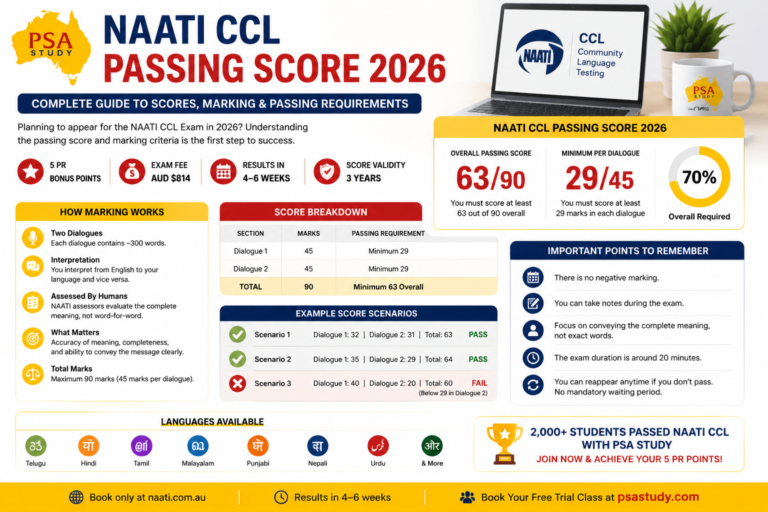
PASS REQUIREMENTS – KNOW BOTH: 63/90 overall AND minimum 29/45 in each dialogue separately. Both must be met simultaneously. A total of 70 with a first dialogue of 26 is a fail. Prepare both dialogues to at least a 32-mark standard.
Week 1: Tamil NAATI CCL Preparation Foundation - Format and Vocabulary Start
Goal: Understand exactly what the exam tests. Begin building the formal Tamil vocabulary register that NAATI CCL requires.
Most Tamil speakers arrive at preparation with strong bilingual fluency. Colloquial Tamil is not the same as the formal institutional Tamil NAATI CCL tests. A GP consultation, a housing tribunal hearing, a Centrelink eligibility review: these require a register and vocabulary that everyday Tamil speech does not cover.
Daily structure:
- Day 1: Exam format study. Two dialogues, five segments each, nine marks per segment, 90 marks total. Read NAATI’s official candidate instructions at naati.com.au. Listen to one Tamil dialogue in full; do not attempt to interpret yet. Absorb the pace, the institutional register, the gap between what you hear and what you would normally say in Tamil.
- Days 2–3: Begin vocabulary preparation with Immigration and Citizenship and Health and Medical, the two highest-frequency categories in Tamil NAATI CCL sittings. Study 15–20 institutional Australian terms per day in sentence context, not in isolation. ‘Bulk billing’ is not learned by reading “bulk billing = மொத்த கட்டணம்“; it is learned by hearing it in a Medicare dialogue where a GP explains it to a Tamil patient.
- Days 4–5: Begin formal register calibration of the gap specific to Tamil preparation. Identify everyday Tamil terms you use colloquially and find the formal institutional equivalents. Build a personal vocabulary list for this category alone.
- Day 6: SBS Tamil radio, 30 minutes of listening. SBS Tamil uses the same English-Tamil code-switching style as NAATI CCL dialogues. This builds an institutional vocabulary register more naturally than list study alone.
- Day 7: Self-test on Week 1 vocabulary. Review the weakest categories
Tamil-specific Week 1 challenge: Formal vs informal register. Tamil has a wider register gap than Hindi between colloquial and formal speech. The Tamil you use at home or with community is often distinctly different from the Tamil appropriate for a family court proceeding or an aged care placement interview.
Week 2: Tamil NAATI CCL Vocabulary Coverage - All 12 Topic Categories
Goal: No category leaves you without a working vocabulary set before your first mock test.
| Day | Topic Categories | Focus |
|---|---|---|
| Day 1 | Legal and Justice | Bail, statutory declaration, restraining order, affidavit, legal aid |
| Day 2 | Employment | WorkCover, Fair Work, redundancy, enterprise agreement, payslip |
| Day 3 | Social Services | Centrelink, NDIS, Jobseeker payment, aged care, concession card |
| Day 4 | Banking and Finance + Housing | Loan application, financial hardship, rental bond, lease agreement |
| Day 5 | Education + Community | TAFE, school enrolment, local council, disability programs |
| Day 6 | Family and Relationships + review | Family court, child support, domestic violence revisit two weakest categories |
Per-category benchmark: By the end of Week 2, produce reasonable formal Tamil equivalents for 80%+ of the 15 highest-frequency terms in each of the 12 categories.
High-risk categories for Tamil candidates: Legal and Justice and Social Services produce the highest vocabulary-related mark deductions for Tamil speakers. Both use Australian institutional terminology exclusively with no equivalent in Indian administrative systems. Allocate double time to these two categories
Week 3: NAATI Tamil Preparation Mock Test Phase
Goal: Identify your actual error patterns under exam pressure, not during relaxed vocabulary review.
This is where preparation becomes performance. The first full mock test almost every Tamil candidate sits reveals problems that vocabulary study alone never exposes: note-taking that breaks down at dialogue speed, third-person narration surfacing under pressure, numbers and dates dropping from interpretations, per-dialogue score imbalances.
Week 3 mock test schedule:
| Day | Activity |
|---|---|
| Day 1 | Full mock test real conditions, record yourself, no pausing |
| Day 2 | Review: score per segment, categorise errors (vocabulary / structural / attention) |
| Day 3 | Fix: targeted vocabulary work on gaps found in Day 1 mock |
| Day 4 | Full mock test same format, record and score per dialogue |
| Day 5 | Review: compare to Day 1 which errors are recurring? Which are resolved? |
| Day 6 | Fix structural errors: third-person narration requires spoken practice, not vocabulary study |
| Day 7 | Rest or light vocabulary review only |
Track both scores after every mock: Overall total + each dialogue separately. If either dialogue drops below 29, the topic categories it covers become Week 3 priorities regardless of your overall total.
Tamil-specific structural risk: Tamil is Subject-Object-Verb. English is Subject-Verb-Object. Under exam pressure, Tamil speakers sometimes produce English output in SOV order, sounding reversed or unnatural to an assessor. Your mock recordings will show this pattern. The fix is a 12-spoken interpretation drill reviewed specifically for word order, not more vocabulary study.
For coached mock tests with segment-level trainer feedback: NAATI CCL Tamil coaching online Australia – PSA Study.
Week 4: Consolidation and NAATI CCL Tamil Exam Readiness
Goal: Make everything from Weeks 1–3 automatic. Consolidation only no new content.
The candidates who underperform after adequate preparation almost always spent Week 4 adding new vocabulary rather than consolidating what they already know. Arriving at the exam with more vocabulary and less confidence in any of it is worse than arriving with 500 well-practised terms.
Week 4 activities:
- Two final mock tests targeting 65+ total and 32+ per dialogue
- Final vocabulary review: 20–30 terms from Week 2 that felt least confident
- Note-taking audit: capturing numbers, dates, and agency names consistently?
- Replay decision rule: uncertain about two or more terms? Use the free replay. Certain? Don’t.
- Day before exam: no new preparation. Read vocabulary notes once. Rest.
Exam-day mindset for Tamil candidates: The most common mark-loss pattern in final exams is hesitating between two possible Tamil terms and delivering both or neither. Commit to your best-attempt Tamil equivalent and deliver it at a natural pace. A paused, uncertain delivery of the correct term scores lower than a confident delivery of the same term. Self-correction mid-sentence, catching your own error, costs nothing.
NAATI CCL Tamil Preparation: Topic Coverage Summary
| Category | Risk Level for Tamil | Key Terms to Master |
|---|---|---|
| Immigration and Citizenship | Medium | Bridging visa, EOI, skills assessment, character requirement |
| Health and Medical | High | Bulk billing, informed consent, mental health plan, pathology |
| Legal and Justice | Very High | Bail, statutory declaration, restraining order, legal aid |
| Employment | High | WorkCover, Fair Work, redundancy, superannuation |
| Social Services | Very High | Centrelink, NDIS, Jobseeker payment, emergency relief |
| Banking and Finance | Medium | Financial hardship, credit rating, mortgage, insurance claim |
| Housing and Accommodation | Medium | Rental bond, lease agreement, eviction notice |
| Education | Low–Medium | TAFE, school enrolment, special needs support |
| Community Services | Low | Local council, disability program, interpreter service |
| Family and Relationships | Medium | Family court, child support, domestic violence |
Frequently Asked Questions
For candidates with strong baseline Tamil and English, four weeks of structured daily preparation is sufficient. PSA Study's 4-week Tamil coaching curriculum achieves a 99% first-sitting pass rate across 2,000+ coached students. Candidates with limited formal Tamil vocabulary or no prior exposure to Australian institutional language may benefit from five to six weeks.
Legal and Justice and Social Services produce the highest vocabulary-related mark losses for Tamil candidates based on PSA Study's coaching data. Both categories use exclusively Australian institutional terminology with no equivalent in Indian administrative systems or everyday Tamil speech.
Four weeks is sufficient for candidates with strong bilingual fluency and two to three hours of daily preparation. The key is following the correct sequence: vocabulary foundation in Weeks 1–2, mock test practice in Week 3, consolidation in Week 4. Candidates who reverse this sequence mock tests first, vocabulary later consistently underperform.
63 out of 90 marks overall AND a minimum of 29 out of 45 in each dialogue separately. Both conditions must be met simultaneously. PSA Study's coaching benchmark is 32–34 marks per dialogue.
Yes. PSA Study's NAATI CCL Tamil coaching online Australia includes live sessions with native Tamil trainers, 500+ domain vocabulary terms across all 12 NAATI CCL topic categories, scored mock tests with per-dialogue tracking, and unlimited coaching until you pass. Free trial class available. Book at psastudy.com/naati-ccl-tamil-coaching-australia/.
2,000+ students coached, 99% pass rate — Book your free NAATI CCL Tamil trial class
Not ready to commit yet? A free mock test is the easiest way to see where you actually stand before booking anything. And if you’re preparing in a different language, PSA Study runs the same structured coaching for Hindi, Telugu, and Malayalam candidates as well.