NAATI CCL Telugu Vocabulary 2026: 150 Essential Words by Topic
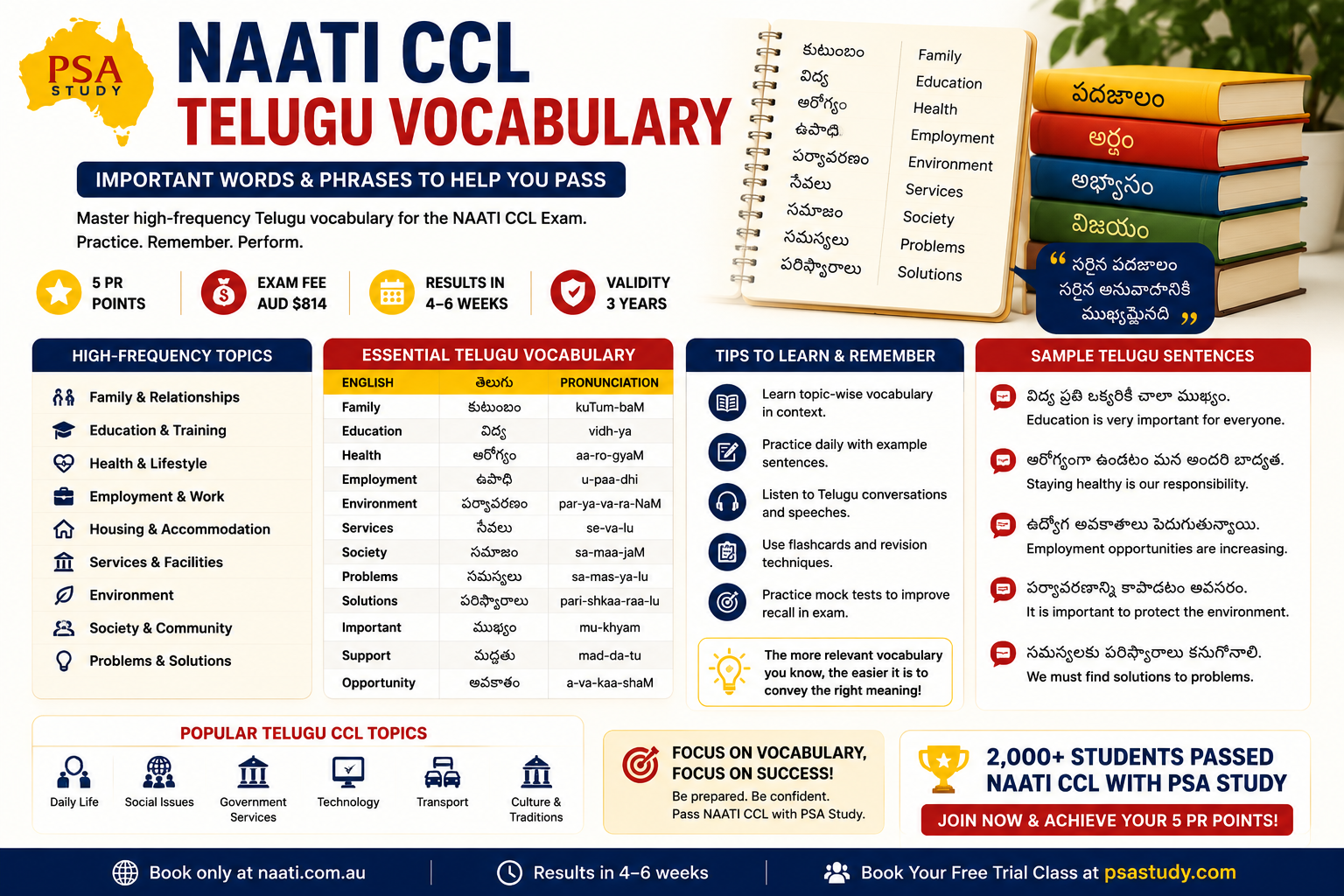
Table of Contents
ToggleNAATI CCL Telugu Vocabulary is often the difference between passing and failing the NAATI CCL exam. Many candidates speak fluent Telugu and have strong English skills, yet still struggle to achieve the required passing score because they are unfamiliar with the specialised vocabulary commonly used in Australian healthcare, legal, education, employment, and government service settings.
One of the most common questions PSA Study’s Telugu trainers hear is, “My Telugu is fluent and my English is good, so why did I score only 51 in the mock test?” In most cases, the issue is not language ability but vocabulary knowledge. Terms such as “Medicare bulk billing”, “WorkCover claim”, “Centrelink Jobseeker Payment”, and “Enduring Power of Attorney” have specific meanings within the Australian system and often do not have direct equivalents in everyday Telugu conversations.
PSA Study’s analysis of more than 2,000 student mock tests shows that vocabulary-related mistakes account for a significant percentage of lost marks. Missing just three or four important terms in a dialogue can reduce a candidate’s score by 15–20 marks, which is often enough to fall below the required passing score of 63 out of 90.
This NAATI CCL Telugu Vocabulary guide is organised around all 12 official NAATI CCL topic categories. Each section includes commonly tested English terms, Telugu translations, practical explanations, and contextual usage examples to help candidates build the vocabulary needed for exam success.
KEY FINDING: PSA Study mock test analysis across 2,000+ Telugu students shows vocabulary errors cause 60–70% of all mark deductions. Missing 3–4 key terms per segment loses 15–20 marks across the exam enough to fail a candidate whose interpreting accuracy is otherwise strong.
Topic 1: Immigration and Citizenship
Immigration dialogues appear consistently across NAATI CCL exams because they reflect the real community interpreting situations where Telugu-speaking migrants most frequently need assistance. These terms cover the core vocabulary of visa processing, PR applications, and citizenship. Master this category before any other.
| English Term | Telugu Equivalent | Context Note |
|---|---|---|
| Permanent Residency (PR) | నైపుణ్య వలస | Primary visa goal for most CCL candidates |
| Skilled migration | నైపుణ్య వలస | Points-based visa pathway for professionals |
| Expression of Interest | ఆసక్తి వ్యక్తీకరణ | EOI lodged in SkillSelect system |
| Skills assessment | నైపుణ్య అంచనా | Required before most skilled visa subclasses |
| Sponsorship / Nomination | స్పాన్సర్షిప్ / నామినేషన్ | State or employer support for visa applications |
| Bridging visa | తాత్కాలిక వీసా | Allows stay while substantive visa is processed |
| Character requirement | వ్యక్తిత్వ అవసరం | Police clearance and conduct standards |
| Biometrics | జీవ మెట్రిక్స్ | Fingerprint and facial scan for visa processing |
| Identity document | గుర్తింపు పత్రం | Passport, birth certificate or equivalent |
| Citizenship ceremony | పౌరసత్వ వేడుక | Formal event conferring citizenship status |
Topic 2: Health and Medical
Medical dialogues carry the highest consequences for vocabulary errors in the entire NAATI CCL exam. A misunderstood dosage instruction, an incorrectly conveyed diagnosis, a mistranslated consent request each changes the clinical meaning, and each costs marks. NAATI assessors deduct 1–2 marks per significant vocabulary error in this category.
| English Term | Telugu Equivalent | Context Note |
|---|---|---|
| General Practitioner (GP) | సాధారణ వైద్యుడు | Patient treated without hospital admission |
| Specialist referral | నిపుణుడికి రెఫరల్ | GP writes a referral to see a specialist |
| Prescription | మందుల చీటీ / ప్రిస్క్రిప్షన్ | Written authority to obtain medication |
| Medicare | మెడికేర్ | Australian government health insurance system |
| Bulk billing | బల్క్ బిల్లింగ్ | Doctor bills Medicare directly no cost to patient |
| Informed consent | సమాచారంతో అంగీకారం | Patient agreement to treatment after understanding risks |
| Mental health plan | మానసిక ఆరోగ్య ప్రణాళిక | GP plan allowing subsidised psychology sessions |
| Pathology test | పాతాలజీ పరీక్ష | Blood tests, urine tests, tissue samples |
| Side effects | దుష్ప్రభావాలు | Unintended effects of medication or treatment |
| Outpatient | ఔట్పేషెంట్ | Patient treated without hospital admission |
Topic 3: Legal and Justice
Legal dialogues use the most specialised vocabulary in the NAATI CCL exam. Every legal term carries a precise statutory meaning. There is no safe approximation for ‘statutory declaration’, ‘bail conditions’, or ‘restraining order’ vague equivalents cost marks, and in legal contexts, 1–3 mark deductions per error are common. Know these terms exactly.
| English Term | Telugu Equivalent | Context Note |
|---|---|---|
| Magistrate | మేజిస్ట్రేట్ | Lower court judge handling less serious matters |
| Defendant | ప్రతివాది | Person accused or being sued in court |
| Plaintiff | వాది | Person bringing the legal case or complaint |
| Bail | జామీను | Conditional release from custody pending trial |
| Statutory declaration | చట్టబద్ధ ప్రకటన | Written sworn statement with legal standing |
| Legal aid | చట్టపరమైన సహాయం | Free legal assistance for eligible persons |
| Restraining order | నిరోధక ఆదేశం | Court order restricting contact or proximity |
| Power of attorney | అటార్నీ అధికారం | Legal authority granted to act for another person |
| Fine / Penalty | జరిమానా | Financial punishment imposed for an offence |
| Affidavit | ప్రమాణపత్రం | Sworn written statement for use in legal proceedings |
Topics 4 & 5: Employment and Social Services
These two categories share a specific challenge for Telugu candidates: both involve Australian institutional systems with no equivalent in India. Terms like WorkCover, Centrelink, NDIS, and enterprise agreement exist only in the Australian context. A Telugu speaker arriving from India with no prior exposure to these systems encounters them in an exam dialogue with zero contextual cues to draw from. That’s where marks disappear.
Employment vocabulary:
- Fair Work Commission (ఫెయిర్ వర్క్ కమిషన్): the national body handling workplace disputes and setting minimum employment conditions
- Award rate (అవార్డు రేటు): the legally mandated minimum pay rate for a specific job classification
- Superannuation (పదవీ విరమణ నిధి): employer contributions to an employee’s retirement savings fund
- WorkCover (వర్క్కవర్): government insurance covering injuries and illness arising from work
- Redundancy (అదనపు పని తొలగింపు): position eliminated due to business restructure, not personal misconduct
- Unfair dismissal (అన్యాయమైన తొలగింపు): termination without proper grounds or correct procedure
- Probationary period (పరీక్షా కాలం): initial employment period with simplified termination conditions
- Payslip (జీతపు చీటీ): written record of wages, tax, and superannuation for each pay period
Social Services vocabulary:
- Centrelink (సెంట్రెలింక్) — the government agency delivering welfare payments and social services across Australia
- Jobseeker payment (ఉద్యోగ అన్వేషి చెల్లింపు) — income support for unemployed people actively seeking work
- Family Tax Benefit (కుటుంబ పన్ను ప్రయోజనం) — government payment to families with dependent children
- NDIS (జాతీయ వికలాంగుల బీమా పథకం) — National Disability Insurance Scheme funding disability support
- Aged care (వృద్ధాప్య సంరక్షణ) — government-subsidised care services for elderly Australians
- Concession card (రాయితీ కార్డు) — card granting discounts on health services, transport, and utilities
- Income threshold (ఆదాయ పరిమితి) — maximum income before a welfare payment reduces or stops
- Emergency relief (అత్యవసర సహాయం) — immediate financial assistance for people in acute hardship
Topics 6–10: Banking, Housing, Education, Community, Family
The remaining five topic categories draw their dialogues from situations that appear less frequently in mock tests but have appeared regularly across NAATI CCL Telugu sittings. Do not skip them candidates who deprioritise Banking and Finance, for instance, sometimes encounter it as their opening dialogue.
- Banking and Finance: loan application (రుణ దరఖాస్తు), financial hardship (ఆర్థిక ఇబ్బంది), insurance claim (బీమా దావా), credit rating (క్రెడిట్ రేటింగ్), mortgage (ఇల్లు తాకట్టు), account dispute (ఖాతా వివాదం)
- Housing and Accommodation: lease agreement (లీజు ఒప్పందం), rental bond (అద్దె పూచీకత్తు), maintenance request (నిర్వహణ అభ్యర్థన), property manager (ఆస్తి నిర్వాహకుడు), eviction notice (నిష్కాసన నోటీసు), utilities (నీరు, విద్యుత్, గ్యాస్)
- Education: school enrolment (పాఠశాల చేరిక), TAFE (వృత్తి విద్య సంస్థ), special needs support (ప్రత్యేక అవసరాల మద్దతు), parent-teacher interview (తల్లిదండ్రుల-ఉపాధ్యాయుల సంభాషణ), truancy (పాఠశాల గైర్హాజరు)
- Community Services: local council (స్థానిక కౌన్సిల్), disability program (వికలాంగుల కార్యక్రమం), community support organisation (సమాజ సహాయ సంస్థ), interpreter service (వ్యాఖ్యాత సేవ)
- Family and Relationships: family court (కుటుంబ న్యాయస్థానం), child support (శిశు సహాయం), domestic violence (గృహ హింస), child protection (శిశు రక్షణ), family mediation (కుటుంబ మధ్యవర్తిత్వం)
How to Actually Study NAATI CCL Telugu Vocabulary
Reading a vocabulary list builds passive recognition. The NAATI CCL exam tests active retrieval under time pressure.
In a real exam segment, you hear a term spoken at normal conversational speed inside a community dialogue context. You have seconds to retrieve the correct Telugu equivalent from memory, capture it in shorthand notes, and deliver an accurate spoken interpretation. Passive recognition — knowing you have seen the term before — is not the same skill. Active retrieval under pressure is.
The preparation method that builds the right skill is dialogue-based vocabulary acquisition. When you encounter ‘informed consent’ inside a mock dialogue where a surgeon explains a procedure to a Telugu patient and asks whether they understand and agree to proceed, that term anchors in memory with context, tone, and consequence. When you encounter it on a word list, it doesn’t. PSA Study’s NAATI CCL Telugu coaching curriculum introduces all 500+ vocabulary terms within actual community dialogues before any standalone vocabulary review because that sequence matters.
A practical daily supplement is SBS Telugu radio. SBS Telugu broadcasts community service announcements, health information, and government advice using exactly the English-Telugu code-switching style that appears in NAATI CCL dialogues. Twenty to thirty minutes of listening per day in the weeks before your exam builds the vocabulary register that the exam tests more naturally than list study alone can achieve.
Additional practices PSA Study Telugu coaches recommend:
- Create topic-labelled flashcard sets — one category per day on a two-week rotation
- Practise interpreting Centrelink letters, Medicare information sheets, and Fair Work fact sheets into natural spoken Telugu
- Record your mock segment interpretations, play them back, and self-assess specifically for omitted terms
- Study vocabulary in complete sentence context — the sentence anchors meaning in a way isolated word pairs cannot
- Allocate extra preparation time to Legal, Social Services, and Employment — these three categories carry the highest unfamiliar-vocabulary risk for Telugu speakers
For structured vocabulary preparation alongside live coaching with native Telugu trainers, see PSA Study’s NAATI CCL Telugu coaching program — 500+ domain-specific terms, all 12 topic categories, and mock tests calibrated to the actual exam format.
Want to understand how marks are calculated before your exam? Read NAATI CCL Passing Score 2026: How Marks Are Calculated.
Frequently Asked Questions
PSA Study recommends a working knowledge of 150–200 high-frequency community terms across all 10 topic categories as a minimum starting foundation. Depth matters more than raw count. A candidate who genuinely understands 150 terms with their Australian institutional context will outperform one who has passively listed 500 words without knowing how or when to use them.
Yes. When a term has no widely understood Telugu equivalent — such as Centrelink, Medicare, NDIS, or WorkCover — using the English term within your Telugu interpretation is accepted practice. It reflects how real community interpreters work in Australia. NAATI assessors recognise this code-switching approach. What matters is that the surrounding interpretation makes the meaning of the English term clear to a Telugu-speaking listener.
Based on PSA Study's mock test data across 2,000+ Telugu students, Legal and Justice and Social Services produce the highest vocabulary-related mark losses. Both categories use institutional English terminology with no equivalent in everyday Telugu or Indian administrative systems. Health and Medical is the third most challenging, particularly for anatomy terms, medication names, and clinical procedure descriptions.
No. The NAATI CCL is entirely spoken — there is no reading, writing, or text component in any language. You hear audio dialogues and speak your interpretations. You may take written notes during the exam in any personal shorthand, but your notes are not assessed. They are for your own use only.
The English institutional terms are identical across all NAATI CCL language exams — Centrelink, Medicare, WorkCover, and NDIS appear in every language's dialogues. What differs is the community language equivalent for each term and the natural code-switching style in each language. PSA Study offers dedicated programs with language-specific vocabulary preparation for Hindi, Tamil, and Malayalam.
The official source for all NAATI CCL exam information is the NAATI website. Candidates can check test dates, exam fees, candidate instructions, booking availability, and policy updates directly on the official NAATI website. Visit NAATI Official Website for the latest information.
Yes. NAATI provides free and paid CCL practice tests to help candidates understand the exam format and prepare more effectively. The free practice test includes a sample dialogue, while paid options may include examiner feedback.