NAATI CCL Telugu Mistakes: 6 Errors That Cost You Marks in 2026
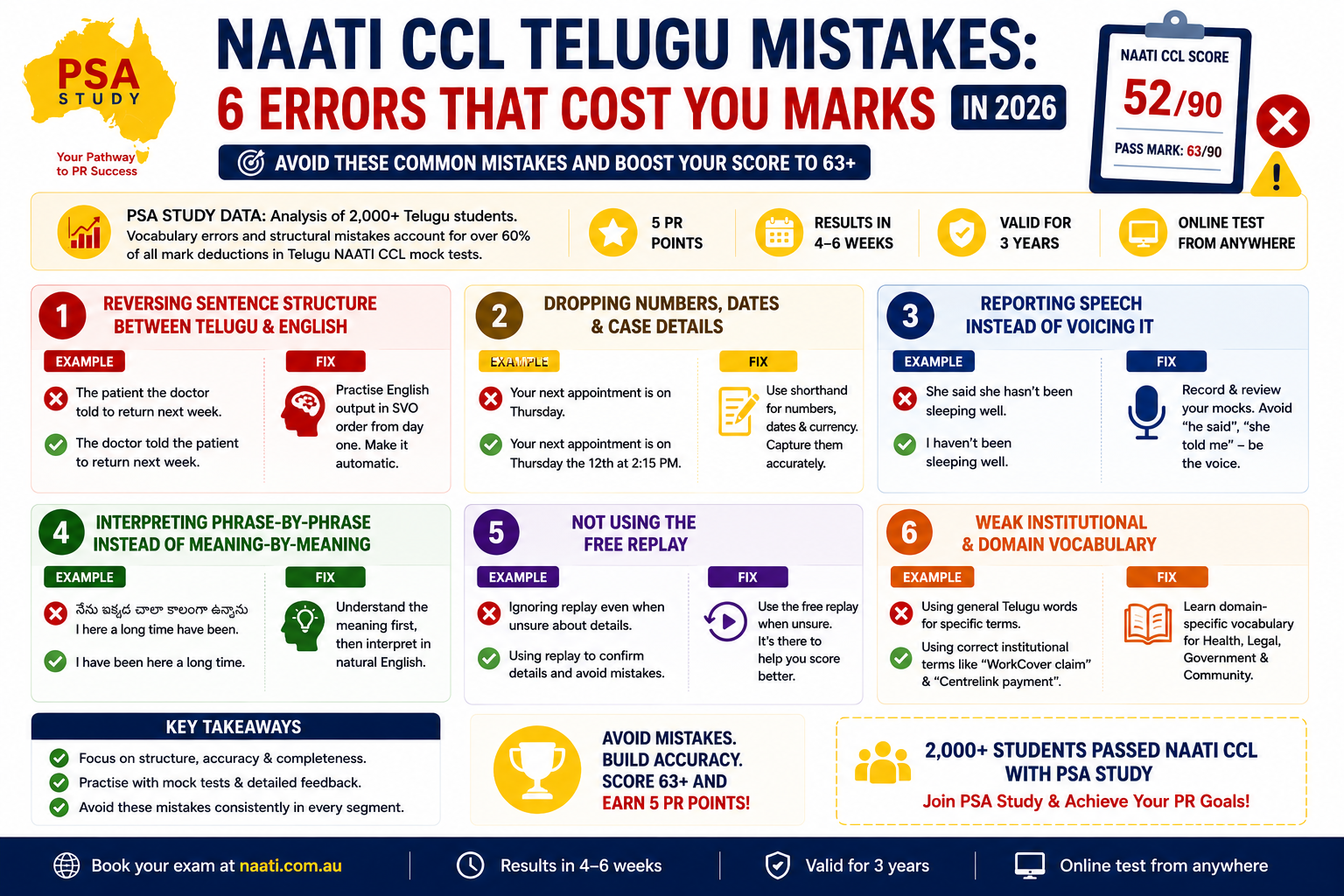
Table of Contents
ToggleNAATI CCL Telugu Mistakes are one of the biggest reasons candidates lose marks in the exam, even when they speak fluent Telugu and have strong English skills. Most score drops are caused by avoidable errors such as incorrect sentence structure, missing numbers or dates, limited Australian vocabulary, and poor interpretation techniques rather than a lack of language ability.
You sat your first NAATI CCL Telugu mock test. Your Telugu is fluent. Your English is strong. You knew the topics you’ve dealt with health appointments and immigration forms during your time in Australia. But the score came back at 52.
The gap between what you expected and what you scored is almost never a language problem. PSA Study’s Telugu coaches see the same six mistakes across every cohort of new students. They appear repeatedly among candidates with strong language skills who simply were never taught what the exam actually penalises.
Here are the six NAATI CCL Telugu mistakes that cost marks and the practical fix for each one.
PSA STUDY DATA: 2,000+ Telugu students coached in Australia. Vocabulary errors and structural mistakes account for over 60% of all mark deductions in Telugu NAATI CCL mock tests. Every mistake below is preventable with structured preparation.
Mistake 1: Reversing Sentence Structure Between Telugu and English
Telugu is Subject-Object-Verb (SOV). English is Subject-Verb-Object (SVO). When a Telugu speaker interprets a Telugu segment into English, the default instinct follows Telugu word order and the English output sounds unnatural, sometimes grammatically unclear, sometimes logically reversed.
An assessor hearing “the patient the doctor told to return next week” instead of “the doctor told the patient to return next week” has to work to catch the meaning. Working harder to understand is not the same as understanding and it reflects in the mark.
The fix: Practise English output in SVO order from day one of preparation. Read English dialogue scripts aloud. Speak English responses before and after Telugu practice sessions. The goal is for SVO sentence construction to operate automatically not something you consciously reassemble mid-interpretation when the pressure is on.
Mistake 2: Dropping Numbers, Dates, and Case Details
Under exam pressure, the brain manages cognitive load by cutting complexity. Numbers go first. Then dates. Then case reference numbers, appointment times, and fine amounts. None of these feel as important as the main narrative of the dialogue until the assessor marks them absent.
In a Health dialogue: “your next appointment is on Thursday the 12th at 2:15 PM” becomes “your next appointment is on Thursday.” That is a one-mark omission deduction. In a Legal dialogue, dropping a fine amount or a court hearing date can attract a two-mark deduction.
The fix: Create dedicated shorthand symbols for numbers, dates, and currency three distinct visual markers your eye catches immediately when reviewing notes. Practise capturing them in isolation during mock test preparation before integrating them into full-segment note-taking. Numbers written in numerals on your notepad take a fraction of the time that writing them out in words does.
Mistake 3: Reporting Speech Instead of Voicing It
In the NAATI CCL exam, you are the voice of the speaker not a narrator describing what the speaker said. When a patient says “I haven’t been sleeping well,” you interpret “I haven’t been sleeping well.” Not “she said she hasn’t been sleeping well.”
Telugu speakers often carry a strong storytelling register third-person indirect speech is natural and common in Telugu narrative contexts. Under exam pressure, this register surfaces without the candidate noticing. It is one of the most consistently penalised structural errors in Telugu NAATI CCL mock tests.
The fix: Record every mock session. Play it back with one specific focus: listen only for “he said,” “she told me,” “they said that.” Each instance is a structural error. The habit breaks across 10–15 mock sessions with deliberate recording and review it does not break on its own.
Mistake 4: Interpreting Phrase-by-Phrase Instead of Meaning-by-Meaning
Telugu uses postpositional phrases and compound verb structures that do not map onto English one-to-one. When candidates interpret phrase by phrase, the English output is fragmented grammatically approximate at best, genuinely unclear at worst.
“నేను ఇక్కడ చాలా కాలంగా ఉన్నాను” interpreted word-for-word becomes something like “I here a long time have been.” Interpreted meaning-first, it is “I have been here a long time.” The second passes. The first may not.
The fix: Listen to the complete segment before beginning to speak. Understand the intent of the segment as a whole. Then deliver it in natural English. This approach requires reliable note-taking which is why note-taking practice and meaning-first interpretation are developed together in PSA Study’s Telugu coaching curriculum.
Mistake 5: Not Using the Free Replay
Every candidate receives one free replay of each segment. PSA Study’s coaching data shows a consistent pattern: candidates who score between 54 and 62 on their first sitting use the free replay significantly less than candidates who score 63 and above.
The replay is there. It costs nothing. Choosing not to use it when you are uncertain about two or more terms means accepting a mark deduction rather than spending four seconds preventing it. The fear that using the replay looks bad to the assessor is unfounded assessors are NAATI-trained examiners following a marking rubric, not making judgements about how confident you appear.
The fix: Build replay use into your mock test habit from the start. Default to using it whenever you are genuinely uncertain not as a fallback or a sign of weakness, but as standard exam strategy. Make the decision rule automatic: uncertain about two or more terms? Replay.
Mistake 6: Underpreparing Legal, Employment, and Social Services Vocabulary
Based on PSA Study’s coaching data across 2,000+ Telugu students, the three topic categories that produce the highest vocabulary-related mark deductions are:
- Legal and Justice
- Social Services
- Employment
All three use Australian institutional vocabulary WorkCover, Centrelink, statutory declaration, bail conditions, NDIS that exists only in the Australian system and has no equivalent in everyday Telugu or Indian administrative contexts. There is no vocabulary shortcut from general Telugu fluency. These terms require direct preparation.
Candidates who allocate most preparation time to Health and Medical because they work in healthcare, and minimal time to Legal because it feels intimidating, are creating exactly the vulnerability that costs them the exam. You do not know which two topics appear in your exam until the audio starts. Every category is a live risk.
The fix: Allocate at least two dedicated preparation sessions to Legal and Social Services vocabulary before your first mock test not after. PSA Study’s Telugu curriculum covers 500+ domain-specific vocabulary terms across all 12 NAATI CCL topic categories, with specific focus on the Australian institutional terms that Telugu speakers find most challenging. Free trial available at psastudy.com/naati-ccl-telugu-coaching-australia/.
What to Do Next
Every mistake above has a fix. None of them require stronger Telugu or stronger English. They require structured preparation consistent mock practice, vocabulary built across all 12 topic categories, and feedback from trainers who know exactly where Telugu speakers lose marks.
Start with a free NAATI CCL mock test at psastudy.com/naati-ccl-mock-test/ to identify which of these six mistakes are already showing up in your practice.
For language-specific preparation guides, see our NAATI CCL Hindi study plan, NAATI CCL Tamil mock test guide, and NAATI CCL Malayalam preparation guide.
Frequently Asked Questions
Telugu is a Subject-Object-Verb language the verb comes at the end of the sentence. English is Subject-Verb-Object the verb follows the subject. Under time pressure, Telugu speakers default to their native syntactic order when building English output. The result is English that sounds reversed or unnatural to an assessor. This is a structural habit that breaks with deliberate practice, not something that improves on its own through general English use.
Yes. NAATI CCL assessors mark omissions of critical information as deductions of 1–3 marks per instance. Numbers, dates, amounts, and case reference codes are considered critical information in community interpreting — because in real-world community settings, a wrong appointment date or dropped fine amount has real consequences for the client. The exam models real stakes.
The most common NAATI CCL Telugu mistakes include reversing sentence structure, omitting numbers and dates, using reported speech instead of direct interpretation, translating word-for-word, ignoring the free replay option, and having limited Australian legal or government vocabulary. Avoiding these mistakes can significantly improve your chances of scoring 63 or above.
PSA Study recommends a minimum of five full mock tests before sitting. The first two typically reveal the structural and vocabulary mistakes above. Tests three through five are about fixing them under consistent exam conditions and confirming that improvements are stable rather than occasional. Most PSA Study Telugu students complete eight to ten mock tests across the four-week program.
Partially. Third-person narration errors and omission patterns appear across all languages. Sentence-structure reversal is more common in Telugu and Tamil (both SOV languages) than in Hindi. Legal and Social Services vocabulary gaps are universal — all four language communities encounter the same Australian institutional terminology challenges. For language-specific guides: NAATI CCL Hindi study plan | NAATI CCL Tamil mock test guide | NAATI CCL Malayalam preparation.
NAATI provides official practice dialogues at naati.com.au these are older test dialogues in PDF and MP3 format across multiple languages including Telugu. They are useful for format familiarity and basic practice but do not include scoring feedback or segment-level analysis. PSA Study's mock tests include trainer feedback identifying which of the six mistake types are showing up in your recordings.
You can avoid NAATI CCL Telugu mistakes by practising with full-length mock tests, improving your note-taking skills, learning topic-specific vocabulary, using the replay option wisely, and getting feedback from experienced NAATI trainers. Regular practice under exam conditions helps reduce errors and builds confidence before the actual test.