NAATI CCL Hindi Study Plan: How to Prepare in 4 Weeks
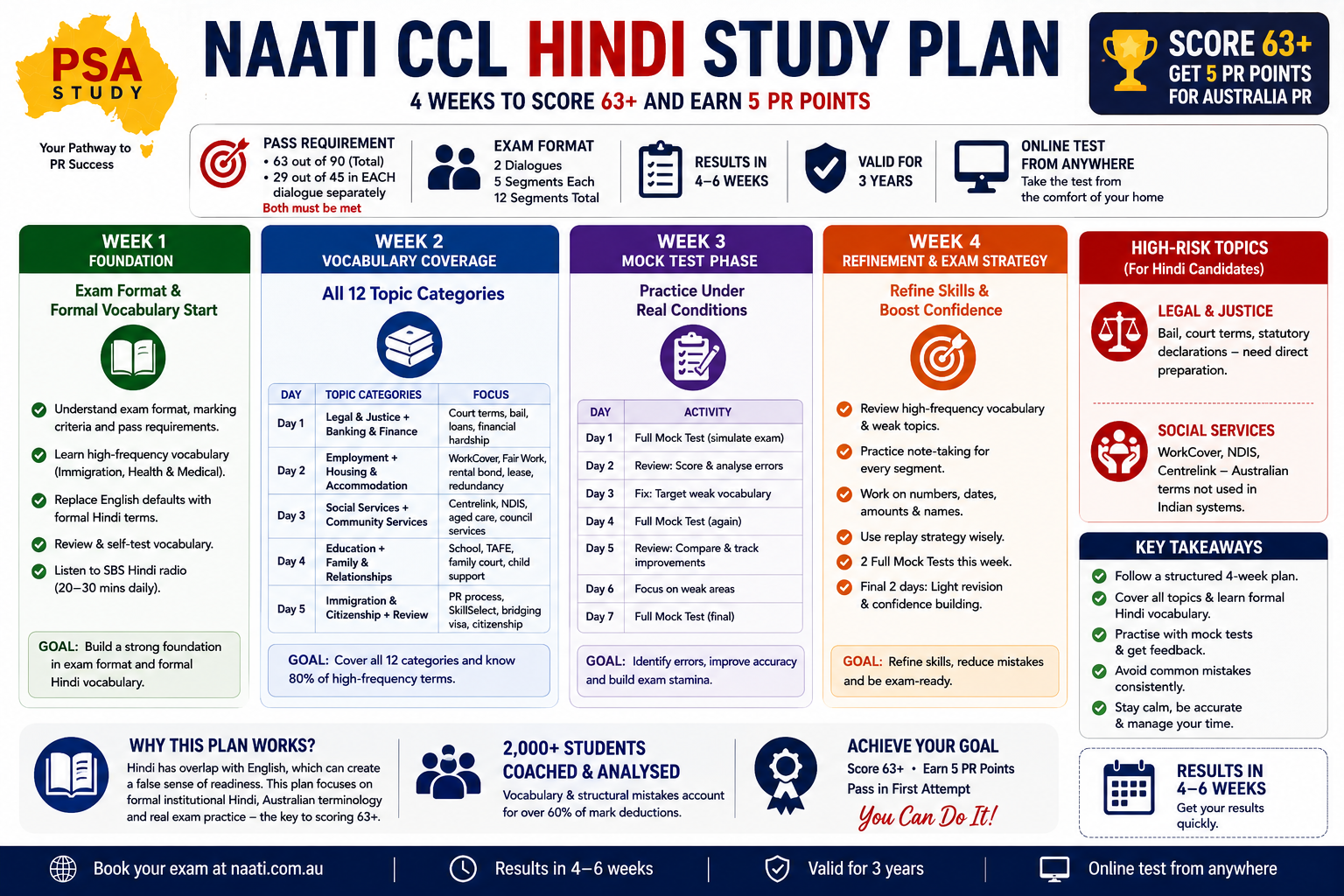
Table of Contents
ToggleA structured NAATI CCL Hindi study plan built around four weeks is enough to take most Hindi-speaking candidates from zero preparation to a 63+ first-sitting pass if those four weeks follow the right sequence.
The keyword is structured. Hindi speakers face a specific preparation trap that this study plan is built around: Hindi has significant vocabulary overlap with English in everyday speech, which creates a false sense of readiness. A candidate who speaks fluent Hindi and functional English can easily underestimate how different the formal institutional Hindi required in NAATI CCL dialogues is from the conversational Hindi used daily. Terms like ज़मानत (bail), सांविधिक घोषणा (statutory declaration), and कार्यकर्ता मुआवज़ा (WorkCover) are not in everyday vocabulary. Neither is formal register the difference between casual conversation and the level of language expected in a GP consultation, a family court proceeding, or a Centrelink review.
This NAATI CCL Hindi study plan is designed specifically around that gap.
PASS REQUIREMENT KNOW BOTH CONDITIONS:
- Total: minimum 63 out of 90 marks across all 12 segments
- Per dialogue: minimum 29 out of 45 in EACH dialogue separately
Both must be met simultaneously. A strong second dialogue does not override a failed first dialogue. Prepare both dialogues to the same standard.
Week 1 - Foundation: Exam Format and Formal Vocabulary Start
Goal: Understand what the exam actually tests, and begin building the formal Hindi vocabulary register that NAATI CCL requires.
Most Hindi speakers come to preparation with conversational fluency. That is necessary but not sufficient. The NAATI CCL exam tests formal community interpreting the Hindi used in a hospital consultation, a housing tribunal, a police matter, or a Centrelink eligibility review. These are not casual conversations. The vocabulary and register are specific, and they don’t come from fluency alone.
Week 1 daily structure:
- Day 1: Exam format study. Two dialogues, five segments each, nine marks per segment, 90 total. Pass requires 63/90 AND 29/45 per dialogue. Download official NAATI CCL practice materials at naati.com.au and listen to one Hindi dialogue in full do not attempt to interpret yet, just absorb the format and pace.
- Days 2–3: Begin vocabulary preparation with Immigration and Citizenship and Health and Medical the two highest-frequency topic categories for Hindi sittings. Study 15–20 formal Hindi terms per day in sentence context, not in isolation.
- Days 4–5: Begin the formal register calibration. For each English term you typically code-switch to in everyday Hindi speech “appointment”, “form”, “payment”, “receipt” identify the formal Hindi equivalent. Build a personal glossary page specifically for English defaults you need to replace.
- Day 6–7: Review and self-test on Week 1 vocabulary. Listen to SBS Hindi radio for 20–30 minutes formal Hindi audio builds the register instinctively alongside vocabulary study.
The Hindi-specific Week 1 challenge: Hindi’s vocabulary overlap with English is a double-edged advantage. It helps comprehension but encourages English defaults in output. NAATI CCL assessors expect the formal Hindi equivalent where one exists. Defaulting to English where Hindi applies costs accuracy marks.
Week 2 - Vocabulary Coverage: All 12 Topic Categories
Goal: No topic category leaves you without a working vocabulary set.
You cannot know which two topics appear in your exam until the audio starts. A candidate who is excellent in Health and Medical and unprepared in Legal and Justice is exposed every time Legal appears which it does, regularly, in Hindi sittings. Allocate time equally to all 12 categories this week.
| Day | Topic Categories | Primary Focus |
|---|---|---|
| Day 1 | Legal and Justice + Banking and Finance | Statutory terms, bail, court vocabulary, loan and financial hardship language |
| Day 2 | Employment + Housing and Accommodation | WorkCover, Fair Work, redundancy, rental bond, lease agreement vocabulary |
| Day 3 | Social Services + Community Services | Centrelink payment types, NDIS, aged care, council services |
| Day 4 | Education + Family and Relationships | School enrolment, TAFE, family court, child support, domestic matters |
| Day 5 | Immigration and Citizenship + review | PR process, SkillSelect, bridging visa, citizenship revisit two weakest categories |
End-of-week benchmark: for each of the 12 categories, you should be able to produce reasonable formal Hindi equivalents for at least 80% of the 15 highest-frequency terms. You will not have perfect recall that comes in Week 3. You need recognition and a reasonable output, not fluency.
High-risk categories for Hindi candidates: Based on PSA Study’s coaching data, Legal and Justice and Social Services produce the highest vocabulary-related mark losses for Hindi speakers. Both require Australian institutional terminology WorkCover, NDIS, statutory declarations that does not exist in Indian administrative systems. These terms need direct preparation, not inference from general Hindi knowledge.
Week 3 - Mock Test Phase: Practice Under Real Conditions
Goal: Identify your actual error patterns under exam pressure, not during relaxed vocabulary review.
This is the week where preparation converts into exam performance. The first full mock test you sit will reveal problems that vocabulary study alone never exposed: note-taking that breaks down at speed, third-person narration emerging under pressure, numbers and dates dropping from interpretations.
Week 3 mock test schedule:
| Day | Activity |
|---|---|
| Day 1 | Full mock test simulate exam conditions, record yourself, no pausing |
| Day 2 | Review: score every segment, categorise errors as vocabulary / structural / attention |
| Day 3 | Fix: targeted vocabulary work on gaps found in Day 1 mock |
| Day 4 | Full mock test same format, record and score |
| Day 5 | Review: compare to Day 1 mock which errors are recurring? Which are fixed? |
| Day 6 | Fix: structural errors (third person, sentence order) need spoken practice, not more vocabulary study |
| Day 7 | Rest or light vocabulary review only |
Tracking both scores: After each mock, calculate your score per dialogue as well as your total. You need 29/45 in each. If one dialogue consistently drops below 29, the topic categories it covered need additional preparation before exam day.
PSA Study’s Hindi coaches review mock test recordings and provide segment-level feedback identifying specifically which error types are recurring and whether the gap is vocabulary, structural, or attention-based. Free trial class available at psastudy.com/naati-ccl-hindi-coaching-australia/.
Week 4 - Exam Readiness: Consistency and Strategy
Goal: Make everything from Weeks 1–3 automatic. No new content consolidation only.
Week 4 is not the time to add new vocabulary categories. The candidates who underperform in the real exam after adequate preparation almost always spent Week 4 expanding rather than consolidating arriving at the exam with more vocabulary and less confidence in any of it.
Week 4 activities:
- Two final full mock tests, targeting 65+ per total and 32+ per dialogue
- Final vocabulary review: 20–30 terms from Week 2 that were least confident one targeted review pass, not re-study from scratch
- Note-taking audit: is your shorthand fast enough? Are numbers and dates captured every time? Test yourself on a two-minute dialogue and check your notes against the script
- Replay decision rule: build a simple personal rule for when to use the free replay. Uncertain about two or more terms? Use it. Certain? Don’t. Make the decision automatic
- Day before exam: no new preparation. Read your vocabulary notes once. Rest
Exam-day mindset for Hindi candidates: The most common mark-loss behaviour in final exams is second-guessing between two possible Hindi terms and pausing visibly while deciding. A candidate who commits to their best-attempt Hindi equivalent and delivers it with natural pace will outscore one who hesitates and delivers the same term with broken fluency. Commit. Deliver. Self-correct only when certain.
Frequently Asked Questions
For candidates with strong baseline Hindi and English skills, four weeks of structured daily preparation is sufficient. PSA Study's four-week Hindi coaching curriculum achieves 99% first-sitting pass rates across 2,000+ coached students. Candidates with weaker formal Hindi vocabulary or limited exposure to Australian institutional language may benefit from five to six weeks.
Yes. A structured NAATI CCL Hindi Study Plan followed consistently for four weeks is enough for many candidates to achieve the required passing score of 63 out of 90. Focus on learning topic-specific vocabulary, practising full-length mock tests, improving note-taking skills, and reviewing your mistakes regularly to maximise your chances of passing on the first attempt.
You need 63 out of 90 marks total AND a minimum of 29 out of 45 marks in each dialogue separately. Both conditions must be met simultaneously. Scoring 38 in one dialogue and 24 in the other gives you 62 total below the pass line and also fails the per-dialogue minimum. Prepare both dialogues to at least 32-mark standard.
NAATI does not publish topic frequency data per language. Based on PSA Study's coaching data, Employment, Social Services, and Legal and Justice are the three categories that produce the highest vocabulary-related mark deductions for Hindi candidates all three require Australian institutional vocabulary that Hindi fluency alone does not provide.
Fluency accelerates the vocabulary learning phase but does not replace the mock test phase. The structural errors that cost marks third-person narration, omissions under pressure, note-taking gaps only become visible under mock test conditions. Even candidates with strong bilingual fluency benefit from the full four-week cycle, with proportionally more time allocated to mock practice and less to basic vocabulary foundation.
The exam format is identical across all four languages. The Hindi-specific challenge is formal vocabulary the gap between conversational Hindi (which includes English code-switching) and the formal institutional Hindi NAATI CCL requires. Telugu and Tamil candidates face an additional sentence-structure challenge (SOV to SVO adjustment). For language-specific guides: NAATI CCL Telugu mistakes | NAATI CCL Tamil mock test guide | NAATI CCL Malayalam preparation.