
NAATI CCL Telugu Mock Test: How to Practice and Score Higher
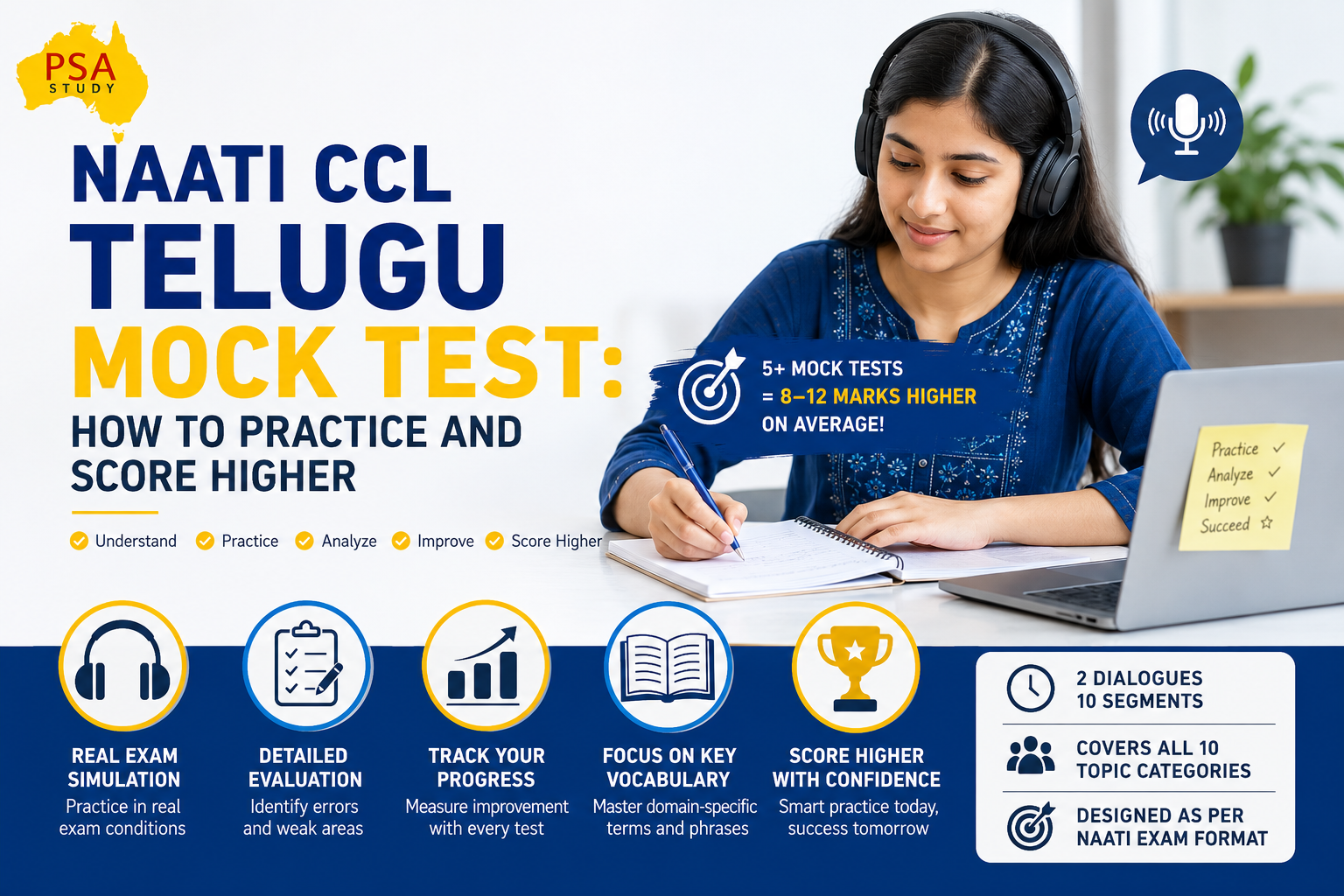
Table of Contents
ToggleThe candidates who pass NAATI CCL Telugu on their first attempt share one consistent habit: they completed at least five full mock tests before sitting.
Not because mock tests show you what to study. Because they show you what’s actually going wrong, the mistakes you didn’t know you were making, the terms that vanish from memory under time pressure, the structural habits that look fine during relaxed practice and fall apart at exam speed.
A NAATI CCL Telugu mock test done properly is a diagnostic tool, not a dress rehearsal. This guide shows you how to turn that data into a higher score.
PSA STUDY DATA: Telugu students who complete 5+ mock tests before their exam score an average of 8–12 marks higher than students who complete fewer than 3. In a 90-mark exam with a 63-mark pass line, that difference is decisive.
What a NAATI CCL Telugu Mock Test Actually Reveals
The first mock test most Telugu candidates sit surprises them not because the dialogue content is harder than expected, but because exam conditions reveal gaps that relaxed study never exposed.
1. Whether your note-taking holds under time pressure. NAATI CCL dialogues run at natural conversation speed with no pausing. Candidates who haven’t practised timed note-taking discover that their shorthand is too slow, or that numbers and case details drop while they focus on the main narrative.
2. Where your actual vocabulary gaps are. You may know “Medicare.” Do you know “Medicare levy,” “bulk billing,” or “mental health care plan”? A mock dialogue surfaces the exact terms you don’t have, something a vocabulary list can’t test, because lists don’t require retrieval under time pressure.
3. Whether you’re voicing or reporting. Telugu speakers sometimes produce interpretations in third person, “she said she cannot afford the medication,” instead of directly voicing “I cannot afford the medication.” This is one of the most consistently penalised errors in Telugu NAATI CCL mock tests, and it only appears under exam pressure.
4. Whether Telugu’s SOV structure is surfacing in your English output. Telugu is Subject-Object-Verb. English is Subject-Verb-Object. Under pressure, Telugu speakers sometimes produce English interpretations in reversed word order, sounding unnatural to an assessor even when every word is correct.
The 5-Step NAATI CCL Telugu Mock Test Process
Step 1: Simulate Real Conditions, No Exceptions
Close every other tab. Phone away. Headphones on, notepad ready. Start the audio and don’t pause it no looking up terms, no replaying beyond your one free replay per segment. A mock test where you pause has taught you nothing about how you perform in an exam, you cannot pause.
Step 2: Record Your Spoken Interpretations
Non-negotiable. You cannot monitor your own delivery while producing it your focus is on the interpreting task, not on catching whether you slipped into third person or dropped a date. The recording is your external observer.
Step 3: Score Each Segment Against the Original
Listen to your recording alongside the original script. For each of the 10 segments, check for omissions, meaning changes, vocabulary errors, extra replays, and third-person narration. Calculate your score per dialogue as well as overall; you need 29/45 in each dialogue, not just 63/90 total.
Step 4: Categorise Every Error, Don’t Just Count Them
Label each deduction as vocabulary (didn’t know the term), structural (knew the term, wrong delivery), or attention (knew the term, dropped it under note-taking pressure). Each category needs a different fix; studying vocabulary won’t fix an attention error, and drilling note-taking won’t fix a genuine vocabulary gap.
Step 5: Fix Before the Next Mock
Improvement happens in the days between mock tests, not during them. Fix the dominant error type from your last mock before sitting the next one, and confirm in that next mock that the fix actually held.
Telugu-Specific Mock Test Focus Areas
SOV-to-SVO conversion under pressure: Watch your recordings specifically for reversed word order in English output. This is invisible in relaxed practice and appears reliably under timed conditions.
Legal, Social Services, and Employment vocabulary: Based on PSA Study’s coaching data across 2,000+ Telugu students, these three categories produce the highest vocabulary-related mark losses, all three use Australian institutional terms with no equivalent in Indian administrative systems.
Per-dialogue scoring: Track Dialogue 1 and Dialogue 2 separately in every mock. A strong total can hide a weak dialogue that would fail you outright.
How Many Mock Tests Before Your Exam?
Start with a free NAATI CCL mock test. For coached mock test preparation with segment-level trainer feedback, see PSA Study’s NAATI CCL Telugu online coaching Australia 500+ domain-specific vocabulary terms, all 10 topic categories, and mock tests calibrated to the actual NAATI exam format. The same coaching structure runs for Hindi, Tamil, and Malayalam candidates as well.
Frequently Asked Questions
Two dialogues of approximately 300 words each, five segments per dialogue, covering two of the ten official topic categories, audio at natural conversational speed, and a one-replay-per-segment limit. Scoring should follow NAATI's deduction model and track both per-dialogue totals and overall total.
Yes. NAATI provides official practice dialogues at naati.com.au older test dialogues in PDF and MP3 format. Useful for format familiarity, but they don't include scoring rubrics or trainer feedback. Self-scoring against the 5-step process above is more useful than completing them without analysis.
Two signals: consistently scoring 65+ across your last three mocks, and your error categorisation showing no new error types only familiar mistakes you're already correcting.
NAATI doesn't publish language-specific pass rate data. Telugu candidates face specific SOV-to-SVO structural risk and vocabulary gaps in Legal and Social Services both addressable with structured preparation.



2 Comments