NAATI CCL Malayalam Mistakes: 6 Errors That Cost You Marks
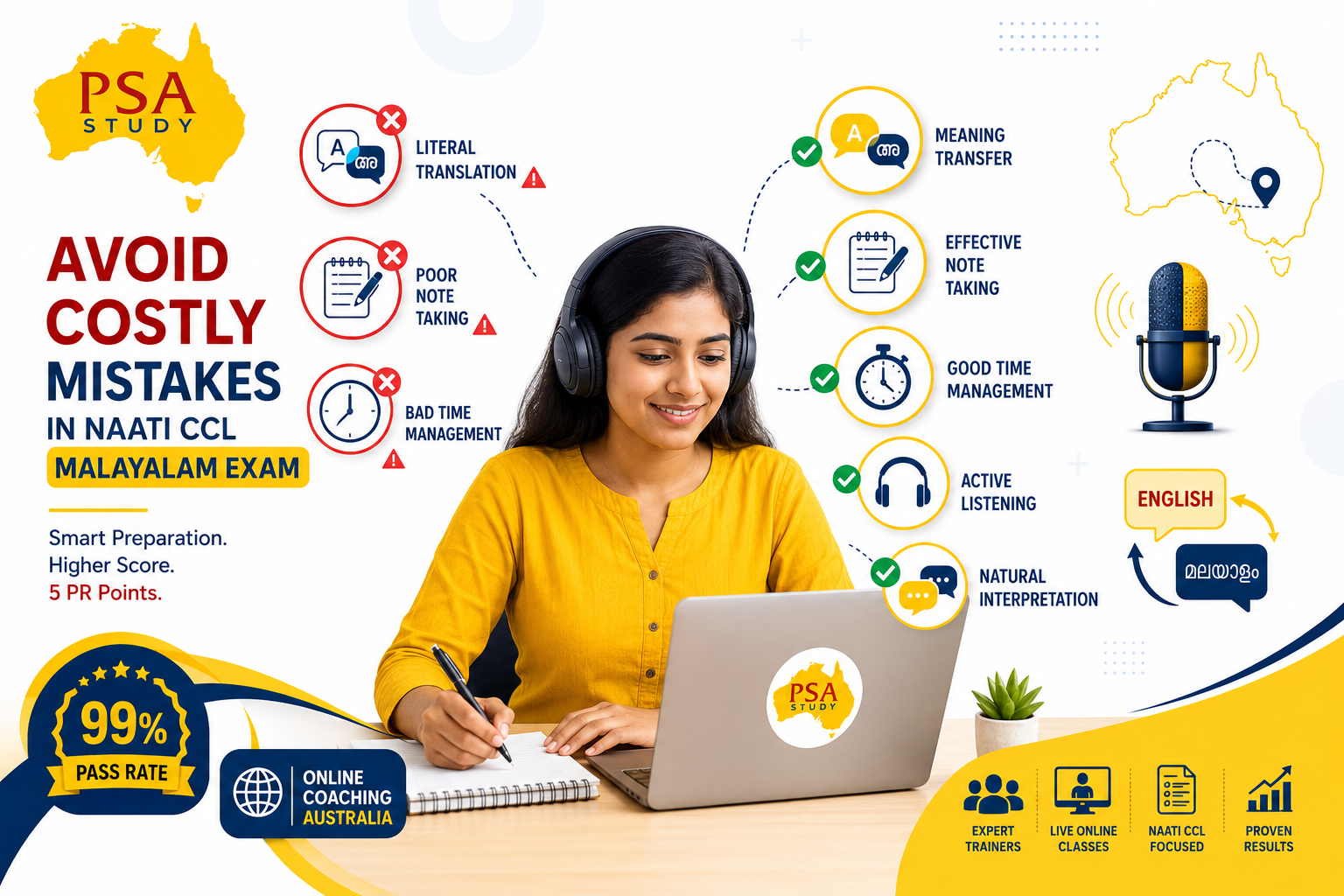
Table of Contents
ToggleYour Malayalam is fluent. Your English is strong. You’ve lived in Australia for years. So why did your first NAATI CCL Malayalam mock test come back at 54?
PSA Study’s Malayalam coaches hear this question in almost every first coaching session. The gap rarely comes from weak language ability. It comes from six specific NAATI CCL Malayalam mistakes that appear across nearly every new student’s early mock tests in the same order, for the same reasons. None of them requires stronger Malayalam or stronger English. All six are fixable once you know what to look for.
PSA STUDY DATA: 2,000+ Malayalam students coached in Australia. Register and vocabulary mistakes account for over 60% of all mark deductions in Malayalam NAATI CCL mock tests and every mistake below is preventable with structured preparation.
How to Avoid NAATI CCL Malayalam Mistakes and Score Higher
Avoiding NAATI CCL Malayalam Mistakes starts with understanding the speaker’s intended meaning instead of translating every word literally. Candidates should practise active listening, develop effective note-taking techniques, expand topic-based vocabulary, and complete regular mock tests under exam conditions. Reviewing your performance after each practice session helps identify recurring errors and improve interpretation accuracy. With consistent preparation and expert feedback, you can reduce common NAATI CCL Malayalam mistakes and significantly increase your chances of passing the exam on your first attempt.
Mistake 1: Interpreting in Colloquial Register Instead of Formal Register
Malayalam carries one of the widest gaps between the everyday spoken register and the formal institutional register of any South Asian language. The Malayalam you speak with family, at community events, or with friends is simply not the Malayalam a family court proceeding or a housing tribunal hearing requires.
Candidates who are highly fluent in colloquial Malayalam sometimes assume that fluency will carry over automatically under exam pressure. It usually doesn’t. An interpretation that’s vocabulary-accurate but delivered in a casual register reads as a language-quality issue to a NAATI assessor, even when every individual word is technically correct.
The fix: Add 20–30 minutes of SBS Malayalam radio daily from Week 1. It uses the same formal, code-switched register that NAATI CCL dialogues use and builds the register instinctively rather than through memorised rules.
Mistake 2: Reporting Speech Instead of Voicing It
In the NAATI CCL exam, you are the voice of the speaker, not a narrator describing what was said. When a patient says “I haven’t been sleeping well,” you interpret “I haven’t been sleeping well.” Not “she said she hasn’t been sleeping well.”
This slip happens because indirect speech feels completely natural in ordinary Malayalam conversation. Under exam pressure, that structure transfers into the interpretation without the candidate noticing, and it’s one of the most consistently penalised structural errors in Malayalam mock tests.
The fix: Record every mock session. Play it back, listening only for “she said” or “he told me” patterns. Each instance is a structural error. The habit breaks across 10–15 recorded and reviewed sessions.
Mistake 3: Tracking Only Your Total Score, Not Per-Dialogue
Candidates prepare for 63 out of 90 and stop checking anything beyond that number. But NAATI CCL Malayalam also requires a minimum of 29 out of 45 in each dialogue separately. A total of 68, with a first dialogue score of 24, is a fail, not a near miss.
This is one of the most Malayalam-specific mistakes PSA Study sees, because candidates who track only the total can be improving steadily on paper. At the same time, one specific dialogue quietly sits below the per-dialogue minimum the entire time.
The fix: Calculate both dialogue scores separately after every mock test. If either dialogue consistently sits below 29, the topic categories it covers become your next priority, regardless of how strong your overall number looks.
Mistake 4: Not Using the Free Replay
Every candidate gets one free replay of each segment. PSA Study’s coaching data shows candidates scoring in the 54–62 range on their first sitting consistently use the free replay less than candidates scoring 63 and above.
The replay costs nothing. Choosing not to use it when uncertain about two or more terms means accepting a mark deduction rather than spending four seconds preventing it.
The fix: Build a simple decision rule and rehearse it in every mock test, uncertain about two or more terms? Replay it. Certain? Don’t. Make the decision automatic before exam day.
Mistake 5: Underpreparing Legal, Social Services, and Employment Vocabulary
Based on PSA Study’s coaching data across 2,000+ Malayalam students, Legal and Justice and Social Services produce the highest vocabulary-related mark deductions. Both categories use Australian institutional vocabulary: statutory declaration, NDIS plan review, Jobseeker payment, WorkCover, with no equivalent in Kerala’s administrative systems.
Candidates who spend most of their preparation time on Health and Medical because it feels familiar, and minimal time on Legal because it feels intimidating, are creating exactly the exposure that costs them the exam.
The fix: Allocate at least two dedicated preparation sessions to Legal and Social Services vocabulary before your first mock test, not after.
Mistake 6: Studying Vocabulary as One Flat List Instead of by Risk
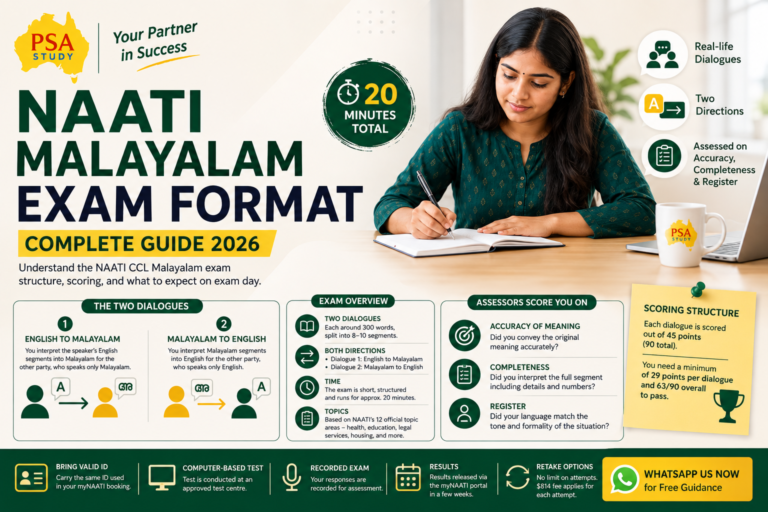
NAATI CCL draws from 12 official topic categories: business, consumer affairs, employment, health, immigration/settlement, legal, community, education, financial, housing, insurance, and social services. Candidates who study vocabulary as one undifferentiated list, working through it top to bottom regardless of category, waste time on lower-risk categories and under-invest in the ones most likely to produce large deductions.
Business and consumer affairs specifically are two categories many candidates skip entirely, assuming they’re less likely to appear, an assumption with no basis, since you don’t choose which two categories your exam draws from.
The fix: Study by category, prioritised by risk. Legal and Social Services first, with double the normal session length. Business, consumer affairs, and insurance next categories that candidates commonly under-prepare simply because they’re less discussed. Everything else after.
What to Do Next
Every mistake above is fixable – and none of them require becoming more fluent in Malayalam or English. Start with a free NAATI CCL mock test to see which of these six mistakes are already appearing in your own recordings. For structured coaching that addresses all six from Week 1, see NAATI CCL Malayalam Coaching – native trainers, 500+ domain vocabulary terms across all 12 topic categories, and scored mock tests with segment-level feedback. PSA Study runs the same coaching model for Telugu, Hindi, and Tamil candidates as well.
Frequently Asked Questions
The most common NAATI CCL Malayalam mistakes are interpreting in colloquial register instead of formal register, reporting speech in third person instead of voicing the speaker directly, tracking only the total score instead of per-dialogue minimums, avoiding the free replay, underpreparing Legal and Social Services vocabulary, and studying vocabulary as one flat list instead of by topic risk. Each one has a specific, learnable fix - see the full breakdown above.
The three biggest challenges are the gap between colloquial and formal register, the unpredictability of which 2 of the 12 official topic categories your exam draws from, and building institutional vocabulary terms like NDIS, Centrelink, and statutory declaration that has no equivalent in everyday Malayalam or Kerala's administrative systems.
Malayalam has a wider gap between colloquial and formal register than most South Asian languages tested by NAATI. Everyday conversational Malayalam the language of family and community differs noticeably from the formal institutional Malayalam a housing tribunal or family court proceeding requires, and this gap only becomes visible under exam pressure.
Most grammar-related deductions in Malayalam NAATI CCL come from register mismatch rather than incorrect grammar itself — casual sentence construction used in a context that requires formal institutional Malayalam. SBS Malayalam radio, government service announcements, and formal news broadcasts build the correct sentence patterns more effectively than grammar drills alone.
Yes. The two most common speaking mistakes are reporting what a speaker said instead of voicing them directly in first person, and hesitating between two possible terms mid-interpretation instead of committing to your best attempt. Both cost marks independently of vocabulary accuracy, and both are correctable through recorded practice.
Typical vocabulary errors cluster in Legal and Justice and Social Services terms like statutory declaration, restraining order, NDIS plan review, and Jobseeker payment, which describe Australian institutional concepts with no Kerala equivalent. Candidates who study Health and Medical vocabulary first because it feels familiar often underprepare these two higher-risk categories.
Improving your Malayalam for NAATI CCL specifically means building formal register command, not general fluency. Daily exposure to formal Malayalam media SBS Malayalam radio and government service announcements combined with practising vocabulary inside full sentences rather than isolated word lists, closes this gap faster than general conversation practice.
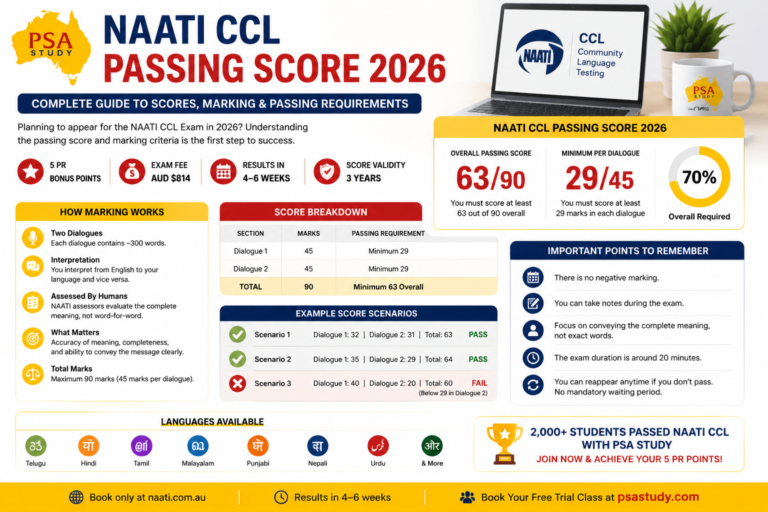
Yes. NAATI CCL Malayalam requires 63 out of 90 overall AND a minimum of 29 out of 45 in each dialogue separately. Both conditions must be met at the same time a strong second dialogue cannot compensate for a first dialogue below 29.
NAATI CCL uses a deduction model starting at 9 marks per segment. Omissions and meaning errors cost 1–3 marks each, vocabulary errors cost 1–2 marks, and each replay beyond your one free replay per segment costs 1 mark. Your final score is 90 marks minus all deductions across both dialogues.
12: business, consumer affairs, employment, health, immigration/settlement, legal, community, education, financial, housing, insurance, and social services. Candidates who prepare for fewer than all 12 are exposed on exam day, since topic selection is outside your control.
Preparation that minimises errors follows a structured sequence: formal vocabulary foundation in Week 1, full coverage of all 12 topic categories by Week 2, mock test practice with error-type review from Week 3, and consolidation in Week 4. Candidates who sit mock tests only in the final week run out of time to fix what those tests reveal.
PSA Study recommends a minimum of five full mock tests. The first two typically reveal the mistakes above. Tests three through five confirm the fixes are holding under consistent exam conditions.
PSA Study's NAATI CCL Malayalam coaching includes scored mock tests with segment-level trainer feedback identifying exactly which error type register, vocabulary, or attention is causing each deduction. Try a free mock test to see this in practice.
NAATI provides official practice dialogues at naati.com.au in PDF and MP3 format across multiple languages including Malayalam. These are useful for format familiarity but don't include scoring feedback, unlike PSA Study's coached mock tests above.