NAATI CCL Coaching Australia 2026: Compare Tamil, Telugu, Malayalam, Hindi
If you’re chasing 5 extra PR points through the NAATI CCL test, you’ve probably already asked the question every South Asian migrant in Australia asks at some point: which language should I sit the exam in, and which coaching program actually gets people through?
This guide answers both. We coach all four languages — Tamil, Telugu, Malayalam and Hindi — at PSA Study, and we’ve put more than 2,000 students through NAATI CCL preparation with a 99% pass rate. That gives us a rare vantage point: we see exactly where students in each language stumble, how long genuine exam-readiness takes, and what a coaching program needs to include to get you there without wasting your time or money.
This is not a “which language is easier” article. NAATI CCL difficulty depends far more on your own bilingual fluency, vocabulary range, and how recently you’ve used your mother tongue for anything beyond casual conversation than it does on which of these four languages you pick. What we can tell you, honestly, is how the exam differs by language in practice, what each cohort of students typically struggles with, and how to choose a coaching path that matches your starting point.
What the NAATI CCL Test Actually Checks (Same Across All Four Languages)
Before comparing languages, it helps to be clear on what stays constant. The Credentialed Community Language Test (CCL) is the same structurally whether you sit it in Tamil, Telugu, Malayalam or Hindi:
- Two dialogues, each roughly 300 words, delivered in segments you interpret consecutively — one English-to-community-language, one community-language-to-English.
- A pass mark of 63 out of 90, with a minimum of 29 in each dialogue.
- Assessment criteria: accuracy and completeness of meaning, and appropriate register — not word-for-word translation, and not paraphrasing that drops details.
- A recorded test, usually 20 minutes total, administered via NAATI’s online platform.
- 5 PR points on successful completion, credentialed for life once passed.
Because the mechanics are identical, most of what separates a strong candidate from a struggling one isn’t the language — it’s preparation method. That’s where coaching quality, not language choice, becomes the deciding factor. If you want to see the test format in a live setting before committing to a program, our NAATI CCL mock test is the fastest way to get an honest read on where you stand.
How to Choose: The Real Decision Factors
Most people don’t actually choose their CCL language — their mother tongue chooses it for them, since NAATI requires a demonstrable connection to the language (through birth, ancestry, or education). But a meaningful number of candidates are genuinely bilingual across two options — Tamil/English, Telugu/English, or growing up with Malayalam or Hindi alongside a state language — and have a real choice to make. If that’s you, weigh these factors instead of asking which language is “easier”:
- Active vocabulary range: Can you comfortably discuss topics like healthcare, banking, immigration, education and workplace disputes in that language — not just family conversation?
- Recency of use: Have you used the language for formal or semi-formal purposes (work, study, official conversations) in the last 2–3 years, or has it mostly been casual/home use?
- Register control: Community languages spoken at home often drift toward informal register. The CCL test specifically checks whether you can shift into the more formal register used in government, medical and legal contexts.
- Availability of structured coaching: A language with strong, specific coaching support (glossary lists, past-pattern practice, examiner-trained tutors) will get you exam-ready faster than one you’re preparing for alone, regardless of which language it is.
- NAATI eligibility rules: Confirm which language(s) you qualify to sit under NAATI’s current CCL language list and your own documented connection to that language.
With that framework, here’s how the four languages compare in practice.
Tamil NAATI CCL: Format, Preparation Considerations & Coaching Approach
Tamil is one of the most heavily sat CCL languages in Australia, driven by strong Tamil-speaking communities in NSW, Victoria and Queensland.
Format: Standard two-dialogue CCL structure. Common dialogue settings include Centrelink/Services Australia interactions, GP consultations, school enrolment, and tenancy disputes.
Preparation considerations: Tamil candidates most often lose marks on register — shifting too far into colloquial Tamil (particularly regional variants) when the dialogue calls for formal register, or over-literal translation of English idiom that doesn’t map naturally onto Tamil sentence structure. Candidates who’ve studied or worked mainly in English for years, with Tamil largely confined to home use, typically need more time rebuilding formal-register vocabulary than candidates who use Tamil actively in community or religious contexts.
Coaching approach that works: Structured terminology building across health, legal, immigration and education domains, paired with dialogue-pattern practice recorded and reviewed against NAATI’s actual marking criteria — not generic conversation practice.
Explore our Tamil NAATI CCL coaching program →
Telugu NAATI CCL: Format, Preparation Considerations & Coaching Approach
Telugu has seen fast growth in CCL candidates over the past few years, tracking the growth of the Telugu-speaking community in Australia’s tech and healthcare sectors.
Format: Same two-dialogue structure. Dialogue topics regularly include workplace safety briefings, aged care conversations, and immigration/visa-related scenarios.
Preparation considerations: A common pattern we see with Telugu candidates is strong spoken fluency but underdeveloped exposure to the specific vocabulary sets NAATI dialogues draw on — insurance terms, medical terminology, and government service names in particular. Candidates who studied through Telugu-medium schooling generally adapt faster to formal register than those who did all schooling in English and speak Telugu only at home; that gap is about vocabulary exposure, not the language’s inherent difficulty.
Coaching approach that works: Domain-specific glossary drilling (health, law, settlement services) combined with timed dialogue practice that mirrors the real 20-minute test format, so candidates build pacing along with vocabulary.
Explore our Telugu NAATI CCL coaching program →
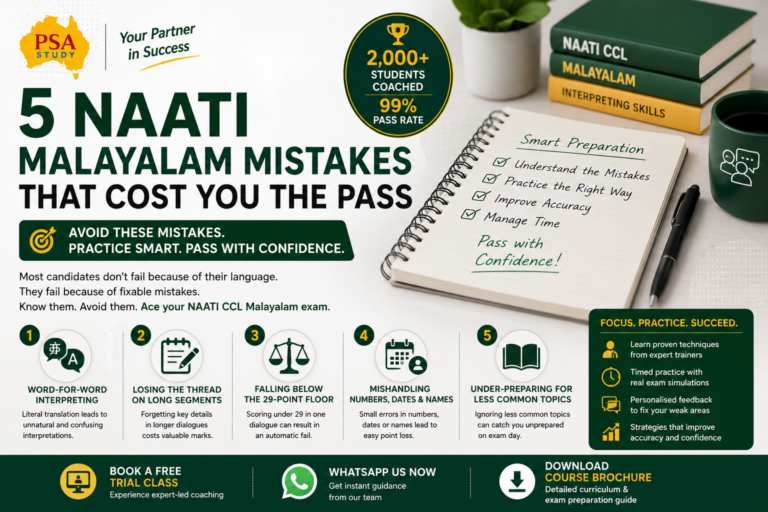
Malayalam NAATI CCL: Format, Preparation Considerations & Coaching Approach
Malayalam candidates in Australia are frequently healthcare professionals — nurses, aged care workers — for whom the 5 PR points are directly tied to permanent residency pathways in a skilled occupation.
Format: Standard structure; dialogues frequently draw on healthcare and aged-care settings given the professional profile of many candidates, alongside standard government-service scenarios.
Preparation considerations: Malayalam candidates often bring strong clinical/professional vocabulary in English but need targeted work translating that into precise, natural Malayalam — direct word-for-word conversion tends to sound stilted and can cost marks on “naturalness” and completeness. Candidates who grew up in Kerala through higher secondary level typically have a head start on formal register; those educated mainly in English from an early age benefit from more structured vocabulary-building before attempting timed practice.
Coaching approach that works: Practice dialogues weighted toward healthcare and community-service scenarios (matching real candidate needs), plus specific coaching on avoiding literal translation in favour of natural equivalent phrasing.
Explore our Malayalam NAATI CCL coaching classes →
Hindi NAATI CCL: Format, Preparation Considerations & Coaching Approach
Hindi is the most widely sat of the four languages nationally, with candidates from a broad range of regional and educational backgrounds across India.
Format: Standard two-dialogue structure, with dialogue content spanning the full range of government, health, education and workplace scenarios.
Preparation considerations: Because Hindi has more registers and regional variation in everyday use than some other CCL languages, candidates sometimes default to a mixed Hindi-English register (“Hinglish”) in casual speech that doesn’t transfer directly to the test, which requires sustained, grammatically complete Hindi. Candidates from Hindi-medium schooling backgrounds usually adapt faster to formal register; candidates whose daily use is mostly conversational and English-mixed typically need more deliberate practice producing complete, formal-register sentences under time pressure.
Coaching approach that works: Register-correction practice (moving from casual/mixed Hindi to test-standard formal Hindi), paired with the same domain-vocabulary and timed-dialogue method used across our other language programs.
Explore our Hindi NAATI CCL coaching program →
Side-by-Side Comparison
| Factor | Tamil | Telugu | Malayalam | Hindi |
|---|---|---|---|---|
| Test format | 2 dialogues, 63/90 pass mark | Same | Same | Same |
| Common candidate profile | Broad community mix | Growing tech/healthcare cohort | Often healthcare/aged care professionals | Widest regional/educational spread |
| Typical mark-loss area | Register shift, literal translation | Domain vocabulary gaps | Literal translation of clinical terms | Casual/mixed-register habits |
| Faster-adapting background | Active community/religious use | Telugu-medium schooling | Kerala schooling through Std 12 | Hindi-medium schooling |
| Slower-adapting background | English-medium, home-only use | English-medium, home-only use | English-medium from early age | Mixed “Hinglish” daily use |
| What coaching should prioritise | Formal-register drills | Domain glossary + pacing | Natural (not literal) phrasing | Register correction |
The pattern across all four is consistent: the deciding factor is prior formal-register exposure, not the language itself. Someone who studied through their mother tongue to secondary level, or who uses it regularly in structured settings (work, community leadership, religious instruction), will generally need less runway than someone whose use has been purely conversational and home-based — and that’s true whether the language is Tamil, Telugu, Malayalam or Hindi.
How Long Should You Prepare?
This is the question coaching programs should answer honestly instead of selling a one-size timeline. Based on our data across 2,000+ students:
- 4–6 weeks is realistic if you use your language regularly in semi-formal settings and just need structured dialogue practice and pacing.
- 8–12 weeks is typical for candidates with solid conversational fluency but limited exposure to formal/technical vocabulary — the largest group across all four languages.
- 12+ weeks is worth planning for if your mother tongue has mostly been a home language for many years and you’re rebuilding active vocabulary from a lower base.
None of these timelines are language-specific. We’ve had Tamil candidates need 12 weeks and Hindi candidates pass comfortably in 5, and the reverse just as often. It comes down to where you’re starting from, not which of the four you’re sitting.
Why Coaching Approach Matters More Than Language Choice
A program that gives you generic conversation practice in your language will not prepare you for CCL — the test rewards specific skills: consecutive memory retention, precise register control, and completeness under time pressure. Across Tamil, Telugu, Malayalam and Hindi, our coaching approach stays consistent because the test structure is consistent:
- Diagnostic assessment to find your actual starting point (not assumed fluency)
- Domain-specific vocabulary building across health, legal, immigration and workplace topics
- Timed dialogue practice that mirrors the real 20-minute test
- Individual feedback against NAATI’s actual marking criteria, not generic language tutoring
- Full-length mock tests before your booked exam date
If you haven’t yet, the fastest way to see where you stand is to try our NAATI CCL mock test — it’s the same format you’ll face on exam day, and it tells you in 20 minutes whether you need 4 weeks of polish or a longer runway.
Frequently Asked Questions
Is one of Tamil, Telugu, Malayalam or Hindi easier to pass than the others?
No. NAATI CCL pass rates depend far more on the individual candidate’s formal-register fluency and preparation than on which language they sit. We coach all four to the same 99% pass rate benchmark using language-specific vocabulary work but the same rigorous method.
Can I choose which language to sit if I’m fluent in more than one?
Sometimes — it depends on NAATI’s eligibility rules and your documented connection to each language. If you’re genuinely bilingual, base your choice on which language you can operate in at a formal register more comfortably, not on which you assume is “easier.”
How many PR points does passing NAATI CCL give me, regardless of language?
5 points, identical across all NAATI-recognised community languages including Tamil, Telugu, Malayalam and Hindi, and credentialed for life once you pass.
Do Tamil, Telugu, Malayalam and Hindi coaching programs at PSA Study differ in structure?
The core method is the same — diagnostic assessment, domain vocabulary, timed dialogue practice, mock testing — but the vocabulary sets, common mark-loss patterns and practice dialogues are tailored to each language, based on patterns we see in real candidates.
What if I’m not sure I’ll pass on my first attempt?
Book a diagnostic session or sit our NAATI CCL mock test before committing to an exam date. It’s far cheaper to find out you need more preparation time before you pay NAATI’s exam fee than after a fail.
Get Started With the Right Program for Your Language
Whichever of the four languages applies to you, the path to a pass looks the same: an honest read of your starting point, structured domain vocabulary, and enough timed practice that the real test feels familiar rather than stressful. We’ve coached this exact path for over 2,000 students across Tamil, Telugu, Malayalam and Hindi, with a 99% pass rate and the same 5 PR points on the other side.
Pick your language program to see language-specific coaching details, batch timings and pricing:
- Tamil NAATI CCL Coaching
- Telugu NAATI CCL Coaching
- Malayalam NAATI CCL Coaching
- Hindi NAATI CCL Coaching
Not sure where to start? Visit the PSA Study homepage for our full range of NAATI CCL and PTE coaching programs, or jump straight into a NAATI CCL mock test to see exactly where your preparation stands today.