Study Plan for PTE Academic: 30 Days to Your Target Score (2026)
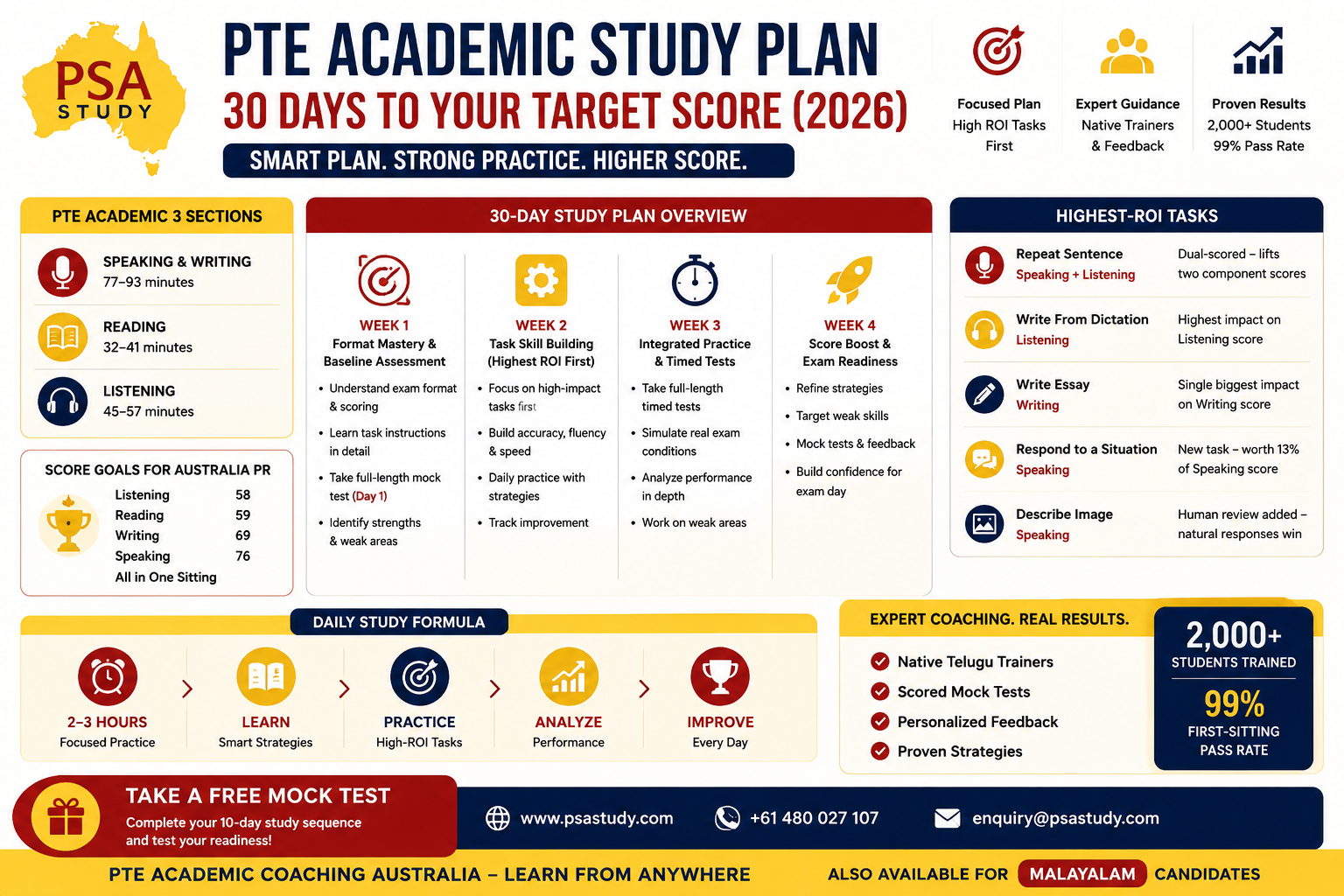
Table of Contents
ToggleMost candidates who resit PTE Academic don’t fail because their English got worse. They fail because they prepared the same way twice. A proper study plan for PTE Academic in 2026 looks different from what most candidates did on their first attempt and different from pre-2025 guides that haven’t been updated for the August format changes.
A study plan for PTE Academic in 2026 needs to reflect the current exam. Two new Speaking tasks were added in August 2025. Read Aloud no longer contributes to Reading. Human reviewers were introduced for Describe Image and Retell Lecture, meaning template-based responses no longer score reliably. Candidates who used pre-2025 preparation materials are working from an outdated blueprint.
This 30-day plan is built around the 2026 exam format and around the specific tasks that drive the most score improvement per hour of preparation.
PSA STUDY BENCHMARK: PTE Academic has 3 sections: Speaking & Writing (S&W), Reading, and Listening. Your total score is a weighted combination of component scores. Proficient English for Australia PR requires Listening 58, Reading 59, Writing 69, and Speaking 76 all in one sitting. Superior English requires higher component minimums. Check pearsonpte.com for current score requirements.
What the 2025 Format Changes Mean for Your Preparation
Before building your study plan, understand what changed in August 2025:
New tasks added to Speaking & Writing:
- Summarize Group Discussion: Listen to a group discussion, summarize key points in your own words. Human reviewers now assess this task — templates are detectable and score lower than genuine responses.
- Respond to a Situation: A practical scenario (social or professional) where you respond verbally. Accounts for approximately 6% of your overall score and 13% of your Speaking score. Completely new — candidates who haven’t practised it will find it unfamiliar on exam day.
Read Aloud scoring change: Read Aloud now only contributes to your Speaking score. It no longer affects your Reading score. Pre-2025 materials that include Read Aloud in Reading preparation are inaccurate.
Human review for templates: Describe Image and Retell Lecture now include human evaluation alongside AI scoring. Memorised template openers (“In the image presented, it can be clearly seen that…”) are detectable and score lower than natural, relevant responses.
What hasn’t changed: Repeat Sentence remains dual-scored (Speaking + Listening). Write From Dictation remains the highest single-task impact on Listening score. The core component structure and overall scoring scale (10–90) are unchanged.
The Highest-ROI Tasks: Where to Spend Your Time
Not all PTE tasks affect your score equally. Before building a daily schedule, understand which tasks drive the most improvement:
| Task | Sections Scored | Why It Matters |
|---|---|---|
| Repeat Sentence | Speaking + Listening | Dual-scored improvement here lifts two components simultaneously |
| Write From Dictation | Listening | Highest individual impact on Listening score |
| Read Aloud | Speaking only (post Aug 2025) | High-frequency task, strong Speaking score driver |
| Essay (Write Essay) | Writing | Single biggest Writing score contributor |
| Summarize Written Text | Writing + Reading | Dual-scored key for both components |
| Respond to a Situation | Speaking | New task worth 13% of Speaking; unpractised candidates lose avoidable marks |
| Describe Image | Speaking | Human review added templates penalised; natural responses required |
| Highlight Correct Summary | Listening + Reading | Dual-scored efficient for both components |
The 30-Day PTE Academic Study Plan
Week 1 Format Mastery and Baseline Assessment
Goal: Understand every task type, know the scoring mechanics, and establish a baseline score.
Day 1: Take a full-length PTE mock test under real conditions before any preparation. Record your component scores. This baseline determines where your 30 days of preparation needs to be concentrated. Do not skip this step.
Days 2–3: Study the exam structure at pearsonpte.com/pte-academic. Focus on understanding:
- Section order: Speaking & Writing → Reading → Listening (no break between sections)
- Time management: PTE does not have per-question time limits in many sections — you manage your time across the full section
- The two new August 2025 tasks: Summarize Group Discussion and Respond to a Situation
- Scoring mechanics: enabling skills (grammar, oral fluency, vocabulary, pronunciation, spelling, written discourse) underpin all component scores
Days 4–5: Practice each task type in isolation — not full tests, just one task type per session. Focus on understanding the format and what each task assesses. For Read Aloud: practise clear pacing, not speed. For Repeat Sentence: immediate recall and natural delivery, not word-for-word perfection.
Days 6–7: Review your Day 1 mock test in detail. For each section, identify whether your score was limited by:
- Task-type unfamiliarity (format, timing, what the task requires)
- Enabling skills gaps (grammar errors, fluency issues, vocabulary range)
- Strategy gaps (time management, skipping difficult items)
This categorisation tells you what Week 2 and 3 should prioritise.
Week 2 Task Skill Building: Highest-ROI First
Goal: Develop reliable performance in the tasks that drive the most score improvement.
Day 8: Repeat Sentence: Repeat Sentence is dual-scored across Speaking and Listening. Every session spent here lifts two component scores. Practice method: listen to the complete sentence before starting to speak. Do not try to write it; notes are not allowed in PTE. Capture the sequence of words, not perfect grammar. Sequence is scored; isolated word accuracy without sequence is not.
Day 9: Write From Dictation: Highest single-task impact on Listening. Every word must be correctly spelled; partial credit is not awarded for close spellings. Practice method: listen twice if available (some practice platforms allow it), write immediately, check against the transcript. Build a personal list of commonly misspelled words in your practice sessions.
Day 10: Essay (Write Essay): PTE essays are 200–300 words, written in 20 minutes. The AI scores grammar, vocabulary, coherence, and development. Human review added in 2025 means template-heavy essays with no genuine development score lower than they did pre-2025. Practice method: write one essay per session, review for grammatical errors and vocabulary range, never repeat the same essay twice.
Day 11: Respond to a Situation: New August 2025 task. Practise responding naturally and relevantly to a professional or social scenario in 20–25 seconds. Avoid starting with filler phrases. State your response position or recommendation in the first sentence. Keep it conversational and purposeful.
Day 12 Read Aloud + Describe Image: Read Aloud: pace, not speed. Natural fluency and accurate pronunciation. Describe Image: avoid memorised templates; describe what’s genuinely visible in the graphic with natural language. Note: human review means template openers now often score lower than genuine descriptive responses.
Days 13–14: Summarize Written Text + Highlight Correct Summary. Both are dual-scored. Summarize Written Text (Writing + Reading): one sentence, under 75 words, capturing the main idea. Highlight Correct Summary (Listening + Reading): listen actively, choose the option that most accurately summarises the spoken text partial marks, so never leave blank.
Week 3 Mock Test Phase: Identify and Fix Real Exam Errors
Goal: Convert task-level skill into full exam performance under real conditions.
Day 15: Full mock test 2. Real conditions: no pausing, no looking up answers, full section timing. Record component scores.
Day 16: Detailed review. Compare to Day 1 baseline and identify:
- Which component improved, and by how much?
- Which tasks within each component are still costing the most marks?
- Are there time management problems in any section?
Days 17–18: Fix. Target the two or three specific tasks causing the most remaining damage. Not a general review, specific practice on the tasks identified in the Day 16 review.
Day 19: Full mock test 3. Same conditions. Compare to mock test 2. Scores should show improvement in targeted areas.
Day 20: Review + strategy calibration. How is your time management? Are you spending too long on early items and rushing later ones? Adjust your per-task time targets based on what the mock revealed.
Days 21–22: Fix remaining weak tasks. Focus on any task type still showing consistent errors. For most candidates at this stage, the remaining gaps are in Write Essay (content development) or Repeat Sentence (sequence accuracy). Both have specific fixable patterns.
Week 4 Consolidation and Exam Readiness
Goal: Lock in consistency. No new techniques automate what you’ve built.
Day 23: Full mock test 4. Your score should now be at or near your target range.
Day 24: Task-level review. Review only the tasks where errors still appeared. Not the full test just the specific items.
Days 25–26: Targeted consolidation. Revisit your personal error log from Weeks 2 and 3. Focus on commonly misspelled WFD words, common grammar errors in essays, and any remaining Repeat Sentence sequence patterns.
Day 27: Final full mock test. This is your readiness confirmation. If you’re hitting your target component scores, you’re ready to sit. If one component is still below target, identify the single highest-impact task in that component and practise it for Days 28–29.
Day 29: Light review only. No new mock tests. Review vocabulary and grammar notes once.
Day 30 (exam day):
- Complete equipment check at pearsonpte.com/pte-academic/before-test-day
- Test your microphone and headphones the evening before
- Read your personal error checklist once you have fixed the patterns in Weeks 2 and 3
- For Speaking tasks: pace before speed, relevance before templates
- For Listening: Write From Dictation comes at the end. Stay focused when you’re most fatigued
What This Study Plan Delivers
| Week | Focus | Output |
|---|---|---|
| Week 1 | Format + baseline | Know exactly where you're starting from and what needs fixing |
| Week 2 | Task skill building | Reliable performance in the highest-ROI tasks |
| Week 3 | Mock test practice | Real exam errors identified and addressed with data |
| Week 4 | Consolidation | Consistent performance under exam conditions |
PSA Study’s PTE coaching program follows this structure 30-day curriculum, AI-scored mock tests after every module, live specialist trainers, and a score guarantee for 1,500+ coached students across Australia.
For current Australia PR score thresholds by English level, check our PTE score breakdown for skilled migration.
Frequently Asked Questions
For candidates with strong English foundations who can dedicate 2–3 hours daily, 30 days is sufficient for most target scores. The key is structured task-level preparation, not general English study. PSA Study's 30-day curriculum achieves a 94% success rate across 1,500+ coached students.
Based on coaching data, Writing is the most common bottleneck for Australian PR candidates targeting Proficient English. Writing requires 69 at the Proficient level, the highest proportional gap from baseline for most non-native speakers. Speaking at 76 is the second most common bottleneck, particularly for candidates with regional accents or limited oral fluency practice.
PSA Study recommends a minimum of four full mock tests across the 30-day preparation cycle: one baseline on Day 1, one at the start of Week 3, one mid-Week 3, and one final test in Week 4. More mock tests without targeted error fixing between them have limited value; the improvement happens in the analysis and fixing, not the repetition.
Two new Speaking tasks were added: Summarize Group Discussion and Respond to a Situation. Read Aloud was changed to affect Speaking only (not Reading). Human reviewers were introduced for Describe Image and Retell Lecture, reducing the effectiveness of memorised templates. Candidates preparing from pre-2025 materials should verify that their resources reflect these updates.
A structured PTE Academic coaching program with live specialist trainers + AI mock tests + score guarantee start your 30-day PTE program
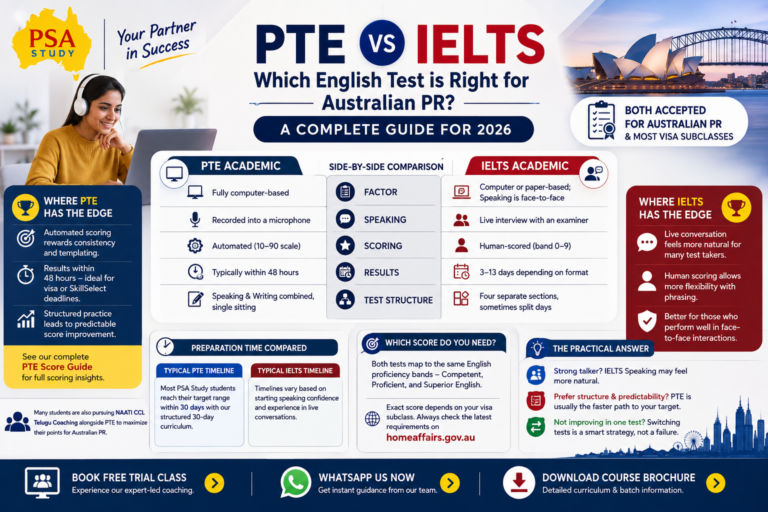
Deciding between PTE and IELTS first? Read Is PTE Easier Than IELTS for Australia PR?
Also earning 5 NAATI CCL PR points? PSA Study coaches all four South Asian languages: NAATI CCL Telugu online coaching Australia plus Hindi, Tamil, and Malayalam programs
Free NAATI CCL practice test: try a mock session here




One Comment