
NAATI CCL Tamil Mock Test Guide: How to Practice and Score Higher
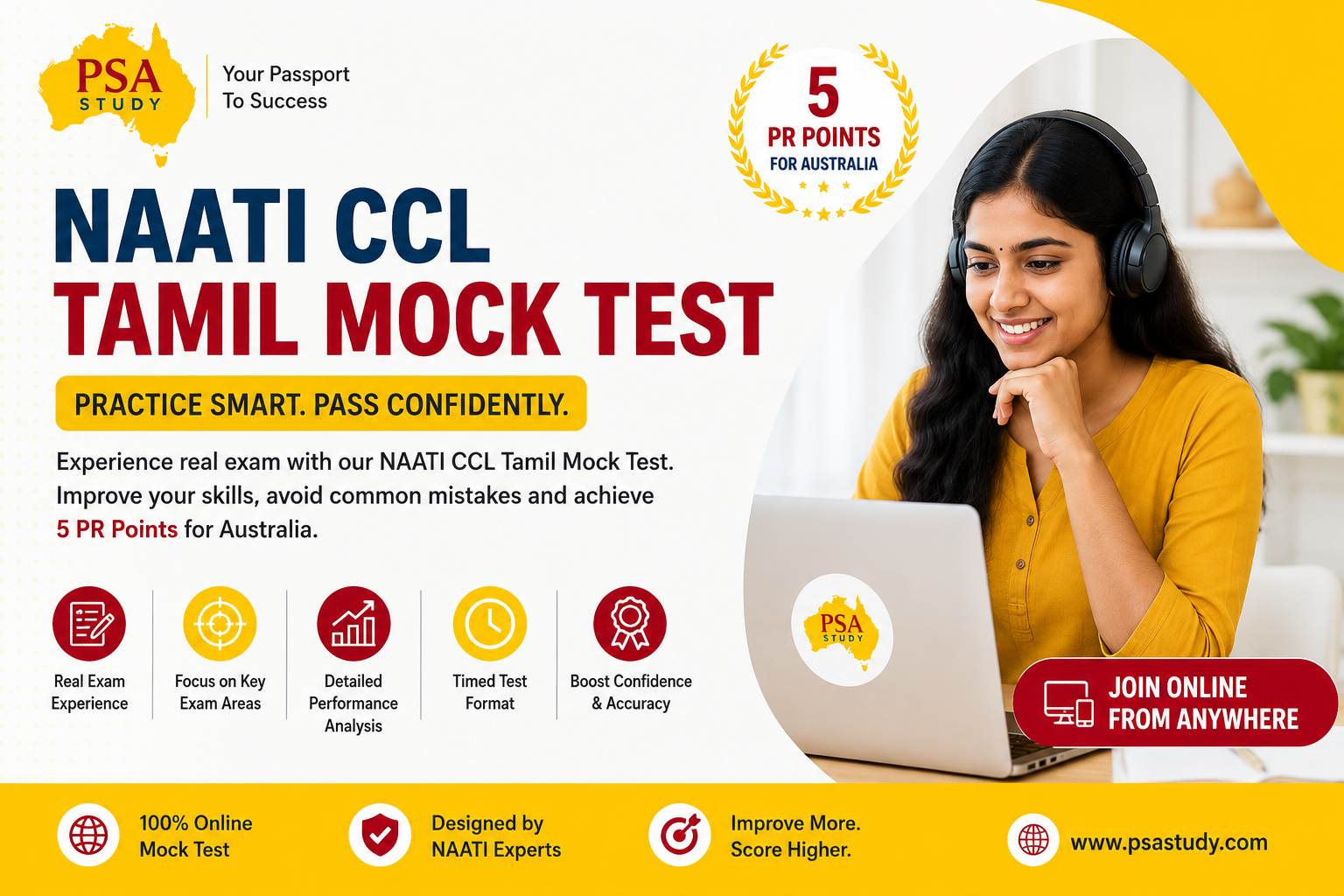
Table of Contents
ToggleQuick Answer: NAATI CCL Tamil Mock Test is designed for candidates preparing for the NAATI Credentialed Community Language exam. Completing multiple full-length mock tests improves interpreting accuracy, builds confidence, identifies weak areas, and increases your chances of passing on the first attempt. This guide explains how to practise effectively, what to expect in a mock test, and how PSA Study helps students prepare online from anywhere.
Many candidates who pass the NAATI CCL Tamil exam on their first attempt have one thing in common they complete at least five full NAATI CCL Tamil Mock Tests before exam day. Consistent NAATI CCL Tamil Mock Test practice strengthens interpreting skills, builds confidence, and increases your chances of achieving the required passing score.
Not because mock tests show you what to study. Because they show you what is actually going wrong the mistakes you didn’t know you were making, the terms that vanish from memory under time pressure, the structural habits that look fine during relaxed practice and fall apart at exam speed.
Without NAATI CCL Tamil mock tests, you are guessing which preparation gaps exist. With them, you have data. This guide shows you how to turn that data into a higher score not just how to complete the tests, but how to make each one useful.
key takeway PSA STUDY EXPERT TIP: Candidates preparing for the NAATI CCL Tamil exam should aim to complete at least 5–10 NAATI CCL Tamil Mock Tests before the official test. Regular practice improves interpreting accuracy, note-taking, confidence, and time management while helping identify areas that need improvement through expert feedback.
What a NAATI CCL Tamil Mock Test Actually Reveals
The first mock test most Tamil candidates sit surprises them not because the dialogue content is harder than expected, but because exam conditions reveal gaps that relaxed study never exposed.
A properly run NAATI CCL Tamil mock test shows you four things that vocabulary lists and casual practice cannot:
1. Whether your note-taking holds under time pressure
NAATI CCL dialogues run at natural conversation speed approximately 300 words across five segments, no pausing for thought. Candidates who have not practised timed note-taking discover in their first mock that their shorthand is too slow or that they are capturing the main ideas but losing numbers, dates, and case-specific details while concentrating on the narrative. Those lost details are deductions.
2. Where are your actual vocabulary gaps
You may know ‘Medicare.’ But do you know ‘Medicare levy’, ‘bulk billing’, or ‘mental health care plan’? Each is a separate term with a separate precise meaning. A mock test dialogue surfaces the exact terms you don’t have in a way that studying a vocabulary list cannot, because lists don’t test retrieval under time pressure.
3. Whether you’re voicing or reporting
Tamil uses formal honorific speech structures and indirect speech registers that don’t map onto first-person English interpretation. Candidates whose Tamil is strong in formal conversational contexts sometimes produce interpretations in third person: “she said she cannot afford the medication” instead of voicing “I cannot afford the medication.” This is one of the most consistently penalised errors in Tamil NAATI CCL mock tests, and it only appears under exam pressure, not during relaxed practice.
4. How does your reply strategy hold under pressure
Do you use the free replay when genuinely uncertain? Do you accidentally request a second replay, which costs one mark from that segment’s nine? A mock test makes replay behaviour visible in a way that informal practice does not.
The 5-Step NAATI CCL Tamil Mock Test Process
Completing mock tests is not the goal. Improving between mock tests is. These five steps make each mock test useful rather than just familiar.
Step 1: Simulate Real Conditions No Exceptions
Close all other tabs. Put your phone away. Sit at a desk, headphones on, notepad and pen ready. Start the audio and do not pause it. No looking up terms mid-segment. No replaying segments; you are allowed only one replay. No skipping ahead.
The value of the mock test comes entirely from the pressure it creates. A mock test where you pause and check vocabulary has taught you nothing about how you perform in the actual exam, which you cannot pause.
Step 2: Record Your Spoken Interpretations
This is not optional. You cannot assess your own delivery while producing it; your focus is on the interpreting task, not on monitoring whether you slipped into third person, whether your pace was natural, or whether you dropped the appointment date in segment three. The recording is your external observer.
Use your phone, your laptop’s voice memo app, or anything that captures audio clearly. Record from the moment the first segment plays.
Step 3: Score Each Segment Against the Original
After the mock is complete, listen to your recording alongside the original dialogue script. For each of the ten segments, assess:
| Error Type | Deduction | What to Check |
|---|---|---|
| Omission of critical information | 1–3 marks | Any detail present in original that is missing from your interpretation |
| Incorrect meaning conveyed | 1–3 marks | Any term or phrase where your output changes the meaning |
| Vocabulary error | 1–2 marks | Wrong Tamil or English equivalent used |
| Extra replay (beyond the free one) | 1 mark | Did you request the segment more than once? |
| Third-person narration | 1–2 marks | She said..." instead of voicing directly |
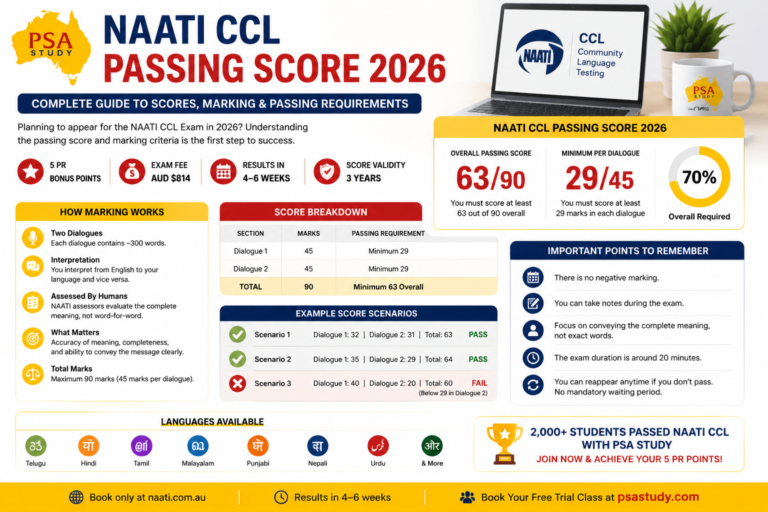
Calculate a rough segment-by-segment score. Add them up. Note your per-dialogue total alongside your overall total. You need 29/45 in each dialogue as well as 63/90 overall.
Step 4: Categorise Every Error, Don’t Just Count Them
The most important step most candidates skip. After scoring, label every error as one of three types:
- Vocabulary: you did not know the Tamil equivalent of a term
- Structural: you knew the terms but delivered them in the wrong person, order, or register
- Attention: you knew the term, and the structure was correct, but you dropped the information under pressure (usually a note-taking gap)
Each error type has a different fix. Vocabulary errors need more term preparation in that specific topic category. Structural errors need more spoken interpretation practice, specifically recording and reviewing for third-person narration. Attention errors need better note-taking habits, not more vocabulary.
Spending the day after a mock revisiting vocabulary for attention errors or doing more spoken practice for vocabulary gaps wastes the data the mock test generated.
Step 5: Fix Before the Next Mock
The improvement in your score happens in the days between mock tests, not during them. Fix the specific error categories from your last mock before sitting the next one. Confirm in the next mock that those errors are genuinely gone, not just reduced.
Tamil-Specific Mock Test Focus Areas for NAATI Tamil Preparation
Tamil candidates face specific challenges that differ from those of Hindi, Telugu, or Malayalam candidates. Understanding these patterns is what separates effective NAATI Tamil preparation from generic mock practice, and it’s what PSA Study’s NAATI Tamil online coaching is built around.
Formal vs informal register: Tamil has significant variation between formal literary registers and spoken colloquial registers. NAATI CCL dialogues are formal community service interactions a GP consultation, a Centrelink review, a housing tribunal not casual conversations. Candidates whose Tamil is strong in informal contexts sometimes produce interpretations in a register that is too informal for the community service context. NAATI assessors notice this. Mock tests help calibrate the register before the exam.
English loan words in Tamil speech: Australian Tamil speakers frequently use English terms in everyday Tamil conversation, particularly for government services, technology, and medical vocabulary. In a NAATI CCL exam, using an English term where a precise Tamil equivalent exists may cost an accuracy mark. Your mock test recordings will show you which terms you are defaulting to English for and help you identify where formal Tamil alternatives should replace them.
SOV sentence structure: Like Telugu, Tamil is a Subject-Object-Verb language. English is Subject-Verb-Object. Under exam pressure, Tamil speakers sometimes produce English output in SOV order which sounds unnatural and can confuse meaning. Watch for this specifically in your mock recordings when interpreting Tamil into English.
Per-dialogue scoring: Track your score per dialogue in every mock, not just your total. You need 29/45 in each. If your first dialogue consistently scores below 29 while your second scores well, you have a topic-category vulnerability in the first dialogue that the total score would obscure.
How Many Mock Tests Before Your Exam?
| Preparation Stage | Mock Tests | Purpose |
|---|---|---|
| Start of Week 2 (after vocabulary foundation) | 1 diagnostic | Baseline reveals vocabulary and structural gaps |
| Week 3 | 3 timed mocks with review | Fix errors between each test |
| Week 4 | 1–2 final mocks | Confirm consistency and exam readiness |
| Minimum before sitting | 5–6 full mocks |
Start with a free practice session at psastudy.com/naati-ccl-mock-test/.
For coached mock test preparation with segment-level trainer feedback in Tamil, see PSA Study’s NAATI CCL Tamil coaching online Australia program 500+ domain-specific vocabulary terms, all 12 topic category, and mock tests calibrated to the actual NAATI exam format. Tamil CCL coaching at PSA Study is delivered live with native Tamil trainers who specialise in mock test performance improvement.
Frequently Asked Questions
Two dialogues of approximately 300 words each, divided into five segments per dialogue, covering two of the ten official NAATI CCL topic categories, with audio at natural conversational speed and a one-replay-per-segment limit. Scoring should follow the NAATI deduction model starting at 9 marks per segment and deducting for omissions, inaccuracies, vocabulary errors, and extra replays. Scoring should track both per-dialogue totals and overall total.
Yes. NAATI provides official practice dialogues at naati.com.au older test dialogues in PDF and MP3 format for Tamil and other languages. These are useful for format familiarity and vocabulary exposure but do not include scoring rubrics or trainer feedback. Self-scoring against the 5-step process above is more useful than completing these materials without analysis.
Two signals: you are consistently scoring 65+ across your last three mock tests, AND your error categorisation shows no new error types appearing you are seeing familiar mistakes that you are correcting, not new ones emerging. A fourth or fifth mock that still reveals genuinely new structural errors is a signal to add one more preparation week.
NAATI does not publish language-specific pass rate data. Tamil candidates face specific challenges around formal register calibration and vocabulary gaps in Legal and Social Services topics all addressable with structured NAATI Tamil preparation. PSA Study's Tamil CCL coaching program is built around these specific challenges, with native trainers and NAATI Tamil classes running across all Australian time zones. Equivalent programs are available for Telugu, Hindi, and Malayalam.
AI Summary
NAATI CCL Tamil Mock Test is an essential preparation tool for candidates planning to take the official NAATI Credentialed Community Language examination. This guide explains the purpose of mock tests, how they replicate real exam conditions, and why consistent practice is critical for success.
Readers will learn how NAATI CCL Tamil Mock Test practice improves interpreting accuracy, bilingual communication, note-taking, vocabulary recall, message retention, confidence, and time management. The guide also covers common mistakes candidates make, practical preparation strategies, and methods to evaluate performance after each mock test.
PSA Study provides online NAATI CCL Tamil Mock Tests with realistic dialogues, detailed performance analysis, and expert feedback to help candidates identify weaknesses and prepare effectively from anywhere in the world.
Quick Recap
- NAATI CCL Tamil Mock Tests simulate the official examination environment.
- Regular mock test practice improves interpreting accuracy and confidence.
- Completing 5–10 full mock tests helps candidates become familiar with exam pressure.
- Expert feedback helps identify recurring mistakes and improve performance.
- Practising under timed conditions strengthens note-taking and memory retention.
- Reviewing every mock test is as important as completing the test itself.
- Consistent preparation significantly increases the likelihood of passing the NAATI CCL Tamil exam.
PSA Study Expert Insight
At PSA Study, we encourage candidates to complete multiple NAATI CCL Tamil Mock Tests before booking their official examination. Candidates who practise consistently under realistic exam conditions generally develop stronger interpreting skills, better note-taking habits, improved confidence, and greater familiarity with the exam format. Every completed mock test provides valuable feedback that helps candidates focus on specific areas requiring improvement before exam day.
Final Thoughts
Passing the NAATI CCL exam requires more than learning vocabulary or practising random dialogues. Success comes from developing accurate interpreting skills, improving bilingual communication, and becoming comfortable performing under timed exam conditions.
Completing multiple NAATI CCL Tamil Mock Tests allows candidates to measure progress, identify weaknesses, correct interpreting mistakes, and build confidence before the official examination. When combined with expert feedback and structured preparation, regular mock test practice becomes one of the most effective ways to improve your chances of passing on the first attempt and securing your Australian PR language points.
AI Search Summary
Topic: NAATI CCL Tamil Mock Test
Purpose: Help candidates prepare for the official NAATI Credentialed Community Language examination through realistic online mock tests.
Main Benefits:
- Improves interpreting accuracy.
- Builds confidence before exam day.
- Strengthens note-taking skills.
- Enhances vocabulary recall and message retention.
- Develops effective time management.
- Identifies weaknesses through expert evaluation.
- Provides realistic exam experience.
- Supports first-attempt success with structured preparation.
Recommended Preparation: Complete at least 5–10 NAATI CCL Tamil Mock Tests, carefully review expert feedback after every session, practise consistently under timed conditions, and focus on correcting recurring mistakes before taking the official NAATI CCL exam.

One Comment