
How to Ace NAATI CCL Malayalam Coaching – 5 Steps
Ready to crack the NAATI CCL Malayalam test and lock in those extra PR points? We’ve laid out the exact actions you need to take, from the exam basics to the final coaching choice. Follow the five steps below and you’ll walk into the test room with confidence
Step 1: Understand the NAATI CCL Malayalam Exam Structure
The NAATI CCL is an online interpreting test that asks you to convey meaning between English and Malayalam in two pre‑recorded dialogues. Each dialogue runs about 300 words and is split into 15‑16 short segments. After every segment a chime sounds and you have five seconds to start interpreting; any pause beyond that can cost marks. The whole session must stay under 20 minutes, or the system flags you for a time penalty.
Scoring is out of 90 marks , 45 per dialogue. You need at least 63 overall and a minimum of 29 per dialogue to pass. Marks are deducted for missed meaning, wrong terminology, and misuse of the repeat or correction controls. The test fee is $814 AUD and you book your slot through the myNAATI portal, which shows live dates in Sydney/Melbourne time.
2,000+students have achieved a 99% pass rate with PSA Study
Step 2: Build Core Vocabulary & Phrase Bank
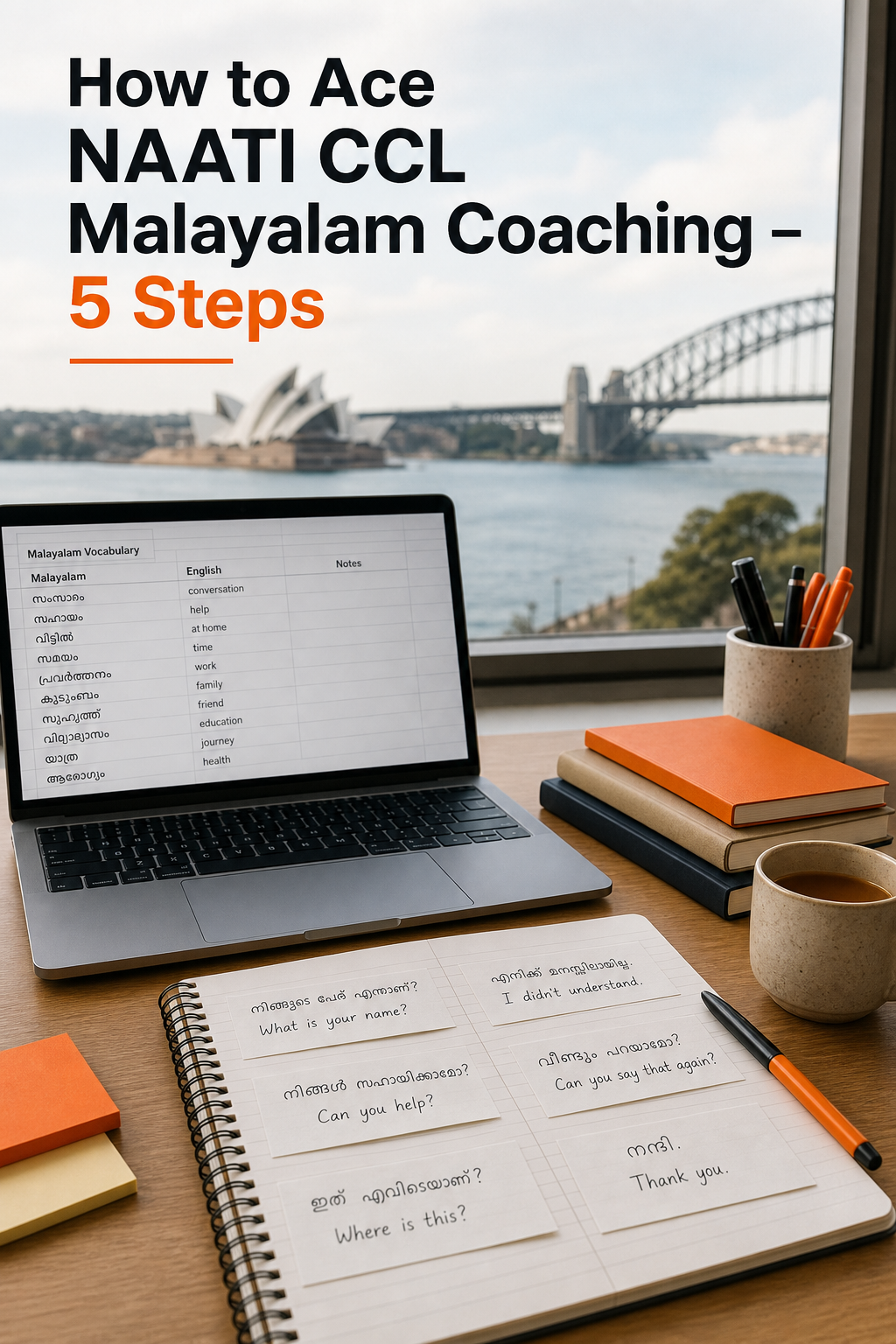
Start with the 500+ terms that NAATI lists for the Malayalam track. Focus on everyday topics , health, housing, finance, and community services , because the dialogues mirror real‑life Australian scenarios. Create a spreadsheet that groups words by theme and adds a short Malayalam example sentence. Review the sheet daily; repetition builds the neural pathways you need for quick recall.
Use the free NAATI CCL app to test yourself on the phrase bank. The app lets you hear the English prompt and type the Malayalam equivalent, giving instant feedback on accuracy.
 When you feel comfortable with the core list, expand it with synonyms and colloquial expressions. This extra layer helps you avoid the “wrong word” penalty that examiners often mark down.
Key Takeaway: A well‑organized phrase bank saves you minutes on test day and reduces the chance of a repeat request.
For more detailed language drills, check out our NAATI CCL online Coaching Centre. The resource includes audio clips and printable note‑taking sheets that align with the exam’s 35‑word segment size.
Step 3: Master Note‑Taking & Repeat Controls
Effective note‑taking means capturing the speaker’s intent, not every single word. Use a simple shorthand: a slash (/) for a pause, an asterisk (*) for a name, and a dash (, ) for a short phrase you’ll flesh out later. Write just enough to cue your interpretation; too much writing slows you down.
The test platform gives you one free repeat per dialogue. Hit the repeat button only when you missed a key term or the speaker spoke too fast. Each repeat costs a small mark deduction, so use it strategically , for example, when a proper noun is unclear.
Pro Tip: After a repeat, jot a quick “repeat used , term X” note. That habit lets you track how often you rely on the feature and helps you cut back in future practice.
Corrections work the same way: you can pause, delete the last segment, and re‑interpret. This is useful if you realise you mis‑heard a number or a date. The system records the correction, but each correction also trims a few marks, so aim for accuracy the first time.
Our students often practice with free practice resources, then replay their recordings to spot note‑taking gaps.
Step 4: Practice Mock Dialogues with Scoring Strategies
The best way to build stamina is to run full‑length mock dialogues under timed conditions. An official practice test is available on the myNAATI portal (official practice test page). Treat the mock as the real exam: set up your laptop, enable the required monitoring software, and use the same headphones you plan to use on test day.
After each mock, compare your score sheet with the marking rubric. Look for patterns , maybe you lose points on numbers, or you over‑use the repeat button. Adjust your study plan accordingly.
 Here’s a quick scoring cheat sheet:
- Missed meaning: , 5 to , 10 marks
- Wrong terminology: , 3 marks
- Unnecessary repeat: , 2 marks
- Corrected after pause: , 1 mark
When you hit the 32, 34 mark range per dialogue, you’re comfortably inside the pass band and ready for the official test.
Our structured mock schedule lives on the Is It Easy to Pass NAATI CCL? page, which shows a week‑by‑week breakdown.
Step 5: Enrol in PSA Study Coaching & Use Free Resources
PSA Study runs a four‑week curriculum that blends live online sessions with on‑demand video drills. The program targets 32, 34 marks per dialogue, which matches the range most successful candidates hit. All classes are led by native‑speaker tutors who know the nuances of Australian‑style Malayalam.
When you sign up, you get a free trial class, access to the full phrase bank, and a library of recorded mock dialogues. The coaching also includes a personalised feedback report after each practice session, so you know exactly where to improve.
Because PSA Study has helped over 2,000 students achieve a 99% pass rate, you can trust the structured plan to deliver results. Book your spot through the exam preparation page, the enrolment form walks you straight to the myNAATI booking screen.
Don’t forget to download the free NAATI CCL app and the practice PDFs that PSA Study provides. They’re great for quick review on the commute.
How many dialogues are in the NAATI CCL test?
There are two dialogues, each worth 45 marks, for a total of 90 marks.
What is the minimum score to pass?
You need at least 63 overall and at least 29 marks in each dialogue.
Can I use a phone or tablet during the test?
Yes, the platform allows a second device for note‑taking, but the primary audio must play on a laptop or desktop.
How many repeats are allowed?
One free repeat per dialogue is provided; using it costs a small mark deduction.
Do I get a refund if I miss my test?
NAATI refunds 75% of the test fee if you cancel at least one hour before the scheduled start time.
Ready to turn your goal into a reality? Enrol with PSA Study today, follow the five‑step plan, and you’ll be on track to earn those five extra PR points. Book your free trial now and start practicing with the official resources.