NAATI Malayalam Exam Format: What to Expect in 2026
The NAATI Malayalam exam format is short — around 20 minutes total — but tightly structured. Knowing exactly what happens before you sit down removes most of the nerves that cost candidates points, and this guide walks through every part of it in the order it actually happens.
Because the exam is so short, there’s very little room to recover from a shaky start the way you might in a longer test. Understanding the format in detail beforehand is one of the highest-leverage things a candidate can do in the final week before their exam date.
The Two Dialogues
The test consists of two role-play dialogues, each roughly 300 words split into 8–10 segments.
Dialogue 1: English to Malayalam
You interpret one speaker’s English segments into Malayalam for the other party, who speaks only Malayalam. This direction tests your ability to receive information in English — often delivered by a service provider, official, or professional — and convey it accurately and naturally to a Malayalam-speaking party.
Dialogue 2: Malayalam to English
The direction reverses — you interpret Malayalam segments into English. This tests the same underlying skill in the opposite direction, and it’s common for candidates to feel noticeably more or less confident in one direction than the other, which is exactly why balanced practice matters so much.
Each dialogue covers everyday or community-service scenarios drawn from NAATI’s 10 official topic areas — health, education, legal services, housing, and similar. The scenarios are designed to feel like real interactions a Malayalam-speaking migrant might genuinely have with an English-speaking service provider, or vice versa.
How the Exam Is Delivered
Segments are played or read at a natural pace, and you interpret each one immediately after it’s spoken — there’s no extended pause to plan your response, which is why timed practice matters more than untimed vocabulary drilling. The natural pacing is deliberate: NAATI is assessing your ability to interpret in something close to real-world conditions, not your ability to produce a polished translation given unlimited time.
This real-time pressure is often the single biggest adjustment for candidates who are strong in Malayalam generally but haven’t specifically practiced interpreting under a ticking clock. Reading comprehension and interpreting under time pressure are related but distinct skills, and the gap between them is exactly what structured, timed practice is designed to close.
Computer-Based Delivery and What Assessors Listen For
NAATI CCL is typically delivered via computer-based testing at approved test centers, with your responses recorded digitally for assessment. Beyond raw accuracy, assessors evaluate completeness (did you convey all the key information in the segment, not just the gist), register appropriateness (does your interpretation match the formality level of the original), and fluency of delivery (is the interpretation delivered smoothly, without excessive hesitation). Understanding these three dimensions helps candidates self-assess their own practice recordings more accurately than simply asking “did I get the words right.”
Scoring Structure
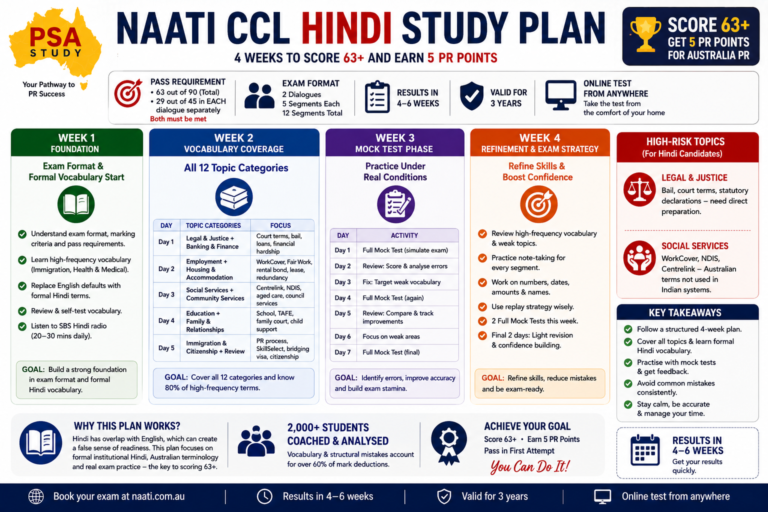
Each dialogue is scored out of 45 points (90 total), with a required minimum of 29 points per dialogue on top of the 63/90 overall pass mark. For the full scoring breakdown, see our NAATI Malayalam Coaching Guide.
Assessors score based on accuracy of meaning transfer, completeness of the response, and appropriateness of register and tone for the scenario — not on a word-for-word match to any single “correct” translation, since natural language allows multiple valid ways to convey the same meaning.
PSA Study Tip
Practice both directions equally. Most candidates are naturally stronger in one direction and under-practice the other, which is exactly where the 29-point floor catches them.
Many students preparing for Malayalam CCL are also exploring our NAATI CCL Hindi Coaching program for family members pursuing the same PR pathway in a different language.
Comparing the Exam Format to Real-World Interpreting Work
It’s worth noting that the NAATI CCL exam format is deliberately modeled on real community interpreting scenarios — the kind of exchange that might genuinely happen between a Malayalam-speaking patient and an English-speaking doctor, or between a Malayalam-speaking parent and an English-speaking school administrator. Candidates who approach their preparation with this framing — practicing as if they’re genuinely helping two people communicate, rather than just trying to “pass a test” — often find their interpreting sounds more natural and scores better on the register and fluency components of the rubric.
What to Bring and Expect on Test Day Logistically
Beyond the exam format itself, candidates should confirm identification requirements, arrive with sufficient buffer time for check-in, and be prepared for a quiet, controlled testing environment similar to other computer-based assessments. None of this affects your interpreting score directly, but arriving rushed or stressed before a 20-minute high-pressure test can measurably affect performance in ways that have nothing to do with actual Malayalam-English proficiency.
Preparing Mentally for the Exam’s Brevity
Twenty minutes feels short, and it is — but that brevity means there’s very little time to recover from an early stumble and very little room for a slow warm-up period. Mentally preparing for this compressed timeline, including practicing your fastest possible settling-in routine, is a genuinely useful part of exam-format preparation that’s easy to overlook when focus is placed entirely on vocabulary and technique.
How This Format Differs from Other Language Assessments
Candidates who’ve previously sat other language proficiency tests sometimes assume NAATI CCL will feel similar, but the format is genuinely distinct. Unlike a general conversation-based speaking assessment, NAATI CCL requires precise, real-time interpreting between two specific parties in a structured role-play — there’s no room for the kind of open-ended, self-directed response common in other formats. This structural difference is exactly why candidates with strong general English or Malayalam speaking ability sometimes still need dedicated NAATI-specific preparation, since the skill being tested is narrower and more specific than general communicative competence.
Why Practicing With a Partner Matters
While solo practice using scripted dialogues builds foundational technique, practicing with a partner who can play the other role — ideally someone who can vary pacing and phrasing slightly from session to session — better simulates the unpredictability of a real exam dialogue. PSA Study’s group coaching sessions build this partnered practice directly into the curriculum, since interpreting a dialogue you’ve memorized the structure of is a meaningfully easier task than interpreting genuinely spontaneous speech.
How PSA Study’s Curriculum Maps to This Exact Format
Every week of PSA Study’s 4-week NAATI CCL Malayalam Coaching program is built around the specific format described in this guide. Week one’s diagnostic identifies where a candidate’s format-specific weaknesses lie — pacing, note-taking, or directional imbalance. Week three’s timed dialogue practice deliberately uses the same roughly 300-word, 8-to-10-segment structure real exam dialogues follow, so candidates aren’t just building general interpreting skill but format-specific familiarity.
Format Familiarity as a Standalone Skill
It’s worth stating directly that format familiarity is a legitimate, separate skill from language proficiency itself, and one that’s often underweighted in self-directed preparation. Two candidates with genuinely equivalent Malayalam-English bilingual ability can produce meaningfully different exam results purely based on how familiar and comfortable each is with the specific structure, pacing, and delivery mechanics of the real test. This is exactly why running multiple full-length mocks in the exact exam format — not just practicing vocabulary or isolated interpreting drills — matters as much as it does.
Common Questions PSA Study Trainers Hear About the Format
Candidates frequently ask whether they can request clarification if they mishear a segment, whether hesitating briefly is automatically penalized, and whether partial or approximate interpretations receive any partial credit. The honest answers matter for calibrating expectations correctly: there’s generally no opportunity to request repetition once a segment plays, brief natural hesitation is treated differently from prolonged, meaning-losing pauses, and assessors do apply nuanced judgment around near-complete, accurate interpretations rather than requiring word-perfect matches.
Why First-Time Exam Nerves Often Center on the Format, Not the Language
Interestingly, when PSA Study trainers debrief students after their first real NAATI CCL Malayalam attempt, the nerves candidates describe most often relate to the unfamiliar mechanics of the format itself — the recording process, the timing cues, the unfamiliarity of speaking into a microphone in a structured test environment — rather than genuine uncertainty about their Malayalam or English ability.
How PSA Study Structures Coaching Around This Exam Format
Every week of PSA Study’s NAATI CCL Malayalam Coaching program is deliberately structured around this exact format — not general Malayalam-English fluency, but the specific 20-minute, two-dialogue, real-time structure described throughout this guide. This distinction matters because generic bilingual confidence, while helpful, doesn’t automatically translate into exam readiness without format-specific practice woven throughout the entire preparation timeline.
Building Genuine Comfort with the Recording Process
Physically rehearsing the flow — not just intellectually understanding it — matters. Confirming identification requirements, test center logistics, and arriving with sufficient buffer time before check-in all reduce unnecessary stress before a genuinely high-pressure 20-minute assessment. Beyond logistics, deliberately practicing with a recording setup similar to the real exam’s — speaking into a microphone in a quiet room, watching a countdown timer — builds a kind of comfort that generic conversational practice never touches, since the real exam’s format itself is part of what candidates need to acclimatise to.
How Format Familiarity Compounds Over a 4-Week Program
Each week of structured practice against this exact format builds on the last, rather than starting fresh. A candidate who has rehearsed the two-dialogue, 20-minute structure a dozen times by week four experiences meaningfully less novelty-driven stress than one encountering the full structure for the very first time on exam day itself. This compounding familiarity is one of the clearest, most measurable benefits structured coaching offers over ad hoc, unstructured self-practice, since it specifically targets the format itself as a trainable skill alongside vocabulary and technique.
Why This Format Guide Matters Before You Book Your Exam
Reading a detailed breakdown of the exam format before scheduling your actual test date, rather than after, gives you the opportunity to genuinely internalize the structure through repeated mock practice before it counts. Candidates who book their exam first and only research the format afterward often find themselves cramming format familiarity in the final week alongside vocabulary and technique review, which spreads preparation too thin across too many priorities simultaneously.
Frequently Asked Questions
How long is the NAATI Malayalam exam format?
The exam itself runs approximately 20 minutes, covering two dialogues of roughly 300 words each, one in each interpreting direction.
Is the NAATI CCL Malayalam exam recorded?
Yes, your interpreting responses are recorded during the test and assessed against NAATI’s official scoring rubric by qualified assessors.
Where do I book the NAATI CCL Malayalam exam?
Bookings are made directly through the myNAATI portal — always confirm current test dates and fees there before scheduling.
Can I request a specific interpreting direction if I’m stronger in one?
No. Every candidate is tested in both directions — English-to-Malayalam and Malayalam-to-English — as part of the same sitting, which is exactly why balanced preparation across both directions is essential rather than optional.
Does the NAATI CCL Malayalam exam format change between test locations?
No. The dialogue structure, timing, and scoring rubric are standardized nationally, whether you sit the exam in Sydney, Melbourne, or any other approved location.
Suggested image: NAATI CCL exam dialogue structure diagram — Alt text: “NAATI Malayalam exam format two dialogue structure”
Book Free Trial Class → | WhatsApp Us Now → | Download Course Brochure