PTE Score Guide 2026: How to Score 79+ (Proven)
If you’re chasing 79+ on the PTE Academic, you already know the number that matters for Australian PR – but almost nobody explains how the score is actually built. This PTE score guide breaks down exactly what the scoring engine rewards, module by module, and the sequence PSA Study uses to get students there in 30 days.
How PTE Scoring Actually Works
PTE Academic scores every response on a 10–90 scale using automated scoring across four communicative skills – Speaking, Writing, Reading, and Listening plus a set of enabling skills (grammar, oral fluency, pronunciation, spelling, vocabulary, and written discourse) that quietly pull your communicative score up or down.
Most students study for the four main skills and ignore the enabling skills entirely. That’s the single biggest reason scores stall in the low-to-mid 60s instead of climbing into the 79+ range.
The scoring engine doesn’t grade tasks in isolation. Several item types are “integrated skills” tasks, meaning a single response feeds into more than one section score at once. Read Aloud, for example, contributes to both your Speaking score and your Reading score. Repeat Sentence feeds both Speaking and Listening. This is why a weak Read Aloud technique can quietly drag down two different section scores at the same time, and why fixing it has an outsized effect on your overall result compared to fixing an isolated task type.
Score Breakdown by Module
| Module | What’s Tested | Where Students Lose Points |
|---|---|---|
| Speaking | Read aloud, repeat sentence, describe image, retell lecture | Oral fluency, pausing, mispronunciation |
| Writing | Summarize written text, essay | Grammar, word count, coherence |
| Reading | Multiple choice, reorder paragraphs, fill in blanks | Vocabulary, time pressure |
| Listening | Summarize spoken text, fill in blanks, highlight correct summary | Note-taking speed, spelling |
How the Enabling Skills Are Weighted
The six enabling skills sit underneath every communicative score, and understanding what each one actually measures is what turns “practice more” into a targeted study plan.
Grammar
Assessed across Speaking and Writing responses – sentence structure accuracy, tense consistency, and correct use of articles and prepositions. Small, repeated grammar slips across multiple tasks compound into a noticeably lower score than one or two isolated mistakes.
Oral Fluency
How smoothly and naturally you speak – rhythm, phrasing, and the absence of unnatural pauses or hesitation. This is the enabling skill most affected by nerves, which is why timed practice under real exam pressure matters more than untimed rehearsal.
Pronunciation
Clarity and correctness of individual sounds and word stress. PTE does not penalise accent – it penalises unclear or mispronounced sounds that a listener would struggle to understand.
Spelling
Assessed in Writing and in Listening tasks like Fill in the Blanks and Write from Dictation. A correct answer with a spelling error still loses marks, which is why spelling accuracy under time pressure is worth dedicated practice.
Vocabulary
Range and appropriateness of word choice across Speaking and Writing. Repetitive or overly simple vocabulary caps your score even when grammar and structure are otherwise strong.
Written Discourse
Applies to the Essay task specifically – logical structure, coherence between paragraphs, and appropriate use of linking words and cohesive devices.
What Separates a 65 from a 79
A 65 gets you Proficient English. A 79+ across all four components is the score most students are actually chasing, since it’s commonly cited as the requirement for Superior English points under SkillSelect – always verify the exact threshold for your visa subclass on the Department of Home Affairs website, since point allocations can change.
The gap between 65 and 79 is rarely about “knowing more English.” It’s almost always about three things:
Enabling Skills Consistency
Pronunciation and oral fluency scores that don’t dip even when you’re speaking fast under time pressure.
Template Discipline
Using a tight, repeatable structure for essays and summarize-text tasks so grammar and coherence scores stay high under time pressure.
Whole-Test Stamina
PTE is a single 2-hour sitting. Scores often drop in the back half of Reading and Listening simply from fatigue, not skill.
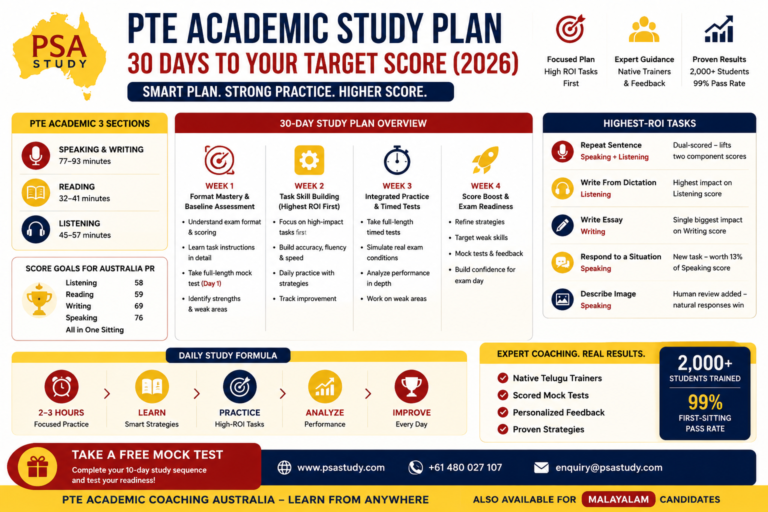
The 30-Day PTE Score Guide Framework
PSA Study’s PTE Online Classes run a structured 30-day curriculum built around this exact gap.
Week 1 – Diagnostic and Enabling Skills
Baseline mock test, then targeted drilling on oral fluency and pronunciation, the two enabling skills that affect the most item types.
Week 2 – Module-by-Module Templates
Repeatable structures for essay, summarize written text, and describe image, so you’re not building responses from scratch under time pressure.
Week 3 – Timed Full-Length Practice
Full mock tests under real exam conditions to build stamina and identify where scores drop late in the test.
Week 4 – Score Guarantee Review and Final Polish
One-on-one review of weak item types with a dedicated trainer before test day.
This is the same structure behind PSA Study’s PTE Online Classes Australia – 1,500+ students coached, a 94% success rate, and a score guarantee backing the program. Several of our students preparing for PR are running this alongside our NAATI CCL Hindi Coaching program, since both credentials can contribute to the same application.
Common Scoring Traps
- Over-editing essays. Spending 15 of your 20 minutes second-guessing word choice instead of hitting the 200–300 word range with clean grammar.
- Silence penalties in Speaking. Any pause over roughly 3 seconds tanks fluency scoring – practice speaking through uncertainty rather than stopping.
- Ignoring spelling in Listening. Fill-in-the-blanks and summarize-spoken-text tasks are graded partly on spelling accuracy, not just comprehension.
- Treating Read Aloud as low-stakes. Because it scores into both Speaking and Reading simultaneously, a weak Read Aloud habit quietly caps two section scores at once.
- Practicing tasks in isolation. Drilling Describe Image alone for weeks builds task familiarity but not exam stamina – the two are different skills, and only full timed mocks build the second one.
Frequently Asked Questions
What PTE score do I need for Australian PR?
It depends on your visa subclass and points target, but 65+ per component is commonly needed for Proficient English, and 79+ per component for Superior English points. Confirm the current thresholds for your subclass on homeaffairs.gov.au before planning your target score.
How long does it take to go from 65 to 79 on PTE?
Most PSA Study students who start around 65 reach 79+ within the 30-day program, provided they complete the full enabling-skills and timed-practice sequence rather than skipping straight to mock tests.
Is PTE easier to improve than IELTS?
PTE’s automated scoring is more consistent and predictable once you understand what the algorithm rewards, which is why templated, structured prep tends to move scores faster than open-ended IELTS speaking practice. See our full PTE vs IELTS comparison for the full breakdown.
Do the enabling skills matter more than the four main skills?
Not more – but they’re weighted into every section score, so a weakness in one enabling skill like oral fluency quietly affects multiple communicative scores at once. That’s why students who plateau in the low 60s almost always have an enabling-skills gap rather than a content gap.
Can I improve my PTE score without a full 30-day program?
Some students with a strong existing English base close the gap faster by focusing on templates and enabling skills, but most benefit from the full diagnostic-to-mock-test sequence, since it’s designed to catch weaknesses a shorter program wouldn’t have time to surface.